Why PDF to Word Conversion Always Loses Formatting (And How to Actually Fix It)
If you are dealing with **pdf to word conversion always loses formatting (and how to actually fix it)**, you are not alone — this is one of the most common PDF…

Every PDF-to-Word converter mangles something: tables break apart, columns interleave, spacing drifts. This is not a matter of picking a better converter. The two formats describe documents in fundamentally incompatible ways, and the conversion has to guess.
Common Causes
- PDF has no document structure — A PDF says "draw this glyph at this coordinate". Word needs paragraphs, styles, tables and lists. None of that exists in the PDF, so the converter infers it from position alone.
- Tables are lines and text, not tables — A PDF table is drawn rules plus separately positioned text. The converter has to deduce cell boundaries from geometry, and it gets it wrong whenever a rule is missing or a cell spans columns.
- Columns are inferred from whitespace — Multi-column layouts are guessed from gaps. A page with a sidebar or a pull quote frequently interleaves.
- PDF is fixed, Word reflows — Word re-wraps text to fit its own margins and available fonts, so line and page breaks will not match.
- Fonts may not exist on the target machine — Substitution changes metrics, which changes wrapping, which changes everything downstream.
Quick Checks to Try First
- Ask whoever sent the PDF for the original Word or Google Docs file first
- Convert a single page to gauge quality before committing to a long document
- Expect tables to need manual repair regardless of the tool
- Consider whether you need to edit the PDF at all rather than convert it
- Keep the PDF as the reference copy while you repair the conversion
Step-by-Step Solutions
Solution 1: Ask for the source document
This is the answer nobody wants and it is the right one. The PDF was exported from something — Word, Google Docs, InDesign, a reporting tool. That original has the structure the PDF discarded. Two minutes asking for it will beat two hours repairing a conversion, and the result will be correct rather than approximately correct.
Solution 2: Edit the PDF instead of converting it
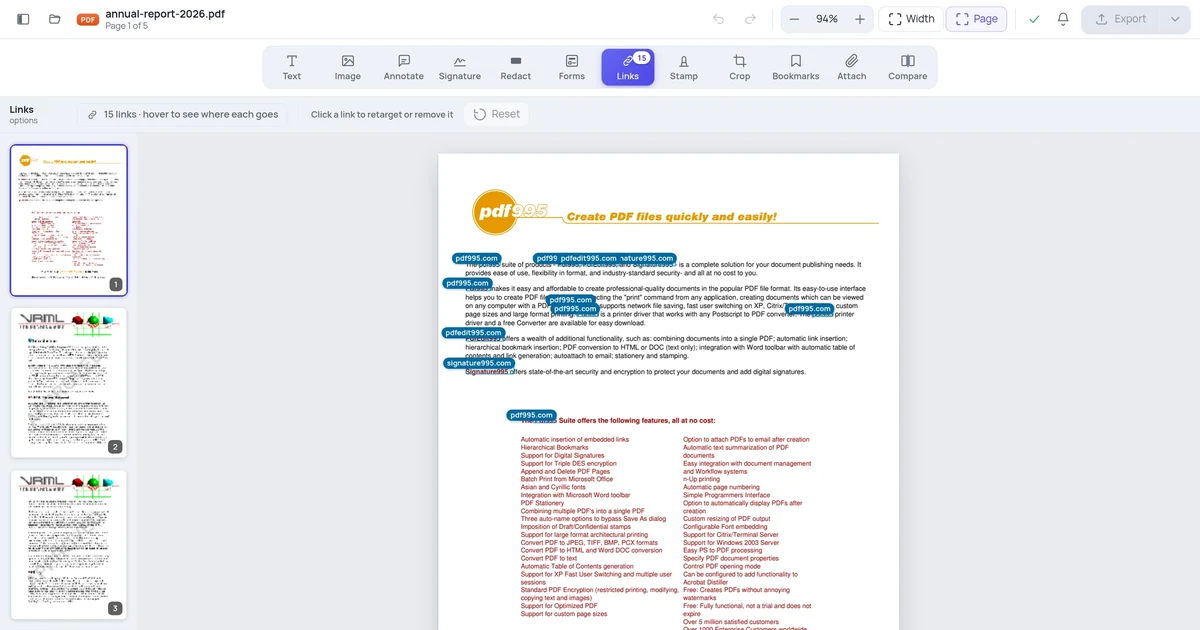
Most people converting to Word only want to change a few things: a price, a date, a name, a paragraph. Converting the whole document to make a small change guarantees a formatting cleanup afterwards. The PDF editor changes the text in the existing file, so everything you did not touch stays exactly as it was — there is no round trip to recover from.
Solution 3: Convert selectively
If you genuinely need the content in Word, convert only the pages you need. Fewer pages means fewer inference errors, and repairing three pages is realistic where repairing eighty is not. Use extract pages to pull out the section first.
Solution 4: Rebuild tables by hand
Accept that tables will need manual work. Convert the document, then rebuild the tables in Word using the PDF alongside as a reference. This is faster and more reliable than trying converter after converter hoping one guesses your particular table geometry correctly.
When None of the Above Works
If you have tried everything and still see the problem, the PDF may have been created with proprietary tools that produce unusual internal structures:
- Contact the document creator and ask for an unlocked or editable version
- Ask for the source file (Word, InDesign) if editing is legitimate
- For government or official forms, check if a fillable online version exists on the official website
How to Prevent This in Future
- Always work on a duplicate — keep the original locked version intact
- When creating PDFs yourself, only apply restrictions you actually need
- Test your PDFs in multiple viewers before distributing
- For editable documents, consider sending the source file (Word / Google Docs) rather than a PDF
- Related reading: How to Reduce the Size of a Digitally Signed PDF
Frequently Asked Questions
Is this a sign of a serious problem? No, and no converter will ever fully solve it. The information Word needs was discarded when the PDF was created.
Can I fix this on my phone? Yes. Open a mobile browser, go to an online PDF editor, upload the file, and try the operation. Many PDF problems that seem to require desktop software are actually just viewer limitations.
Will fixing this delete my document content? No. The steps above modify how the PDF is processed, not the underlying content. Always work on a copy to be safe.
How long does it take to fix? Getting the source file is quickest. Editing the PDF directly avoids the problem. A manual repair scales with the number of tables.