PDF Too Large to Email? Compress It Without Losing Quality (2026)
Hit an attachment limit? Learn exactly why PDFs bloat and how to compress them below every major email provider's cap — without wrecking quality.

You attach a PDF, hit Send, and get an error. File too large. This is one of the most common PDF problems people run into, alongside PDFs that refuse to open. The good news: most PDFs are larger than they need to be, and compression can cut them down without any visible quality loss. This guide covers why PDFs balloon, what every major email provider actually allows, and how to fix it in under two minutes.
Why PDFs Get So Large
A PDF file is a container, and like any container, it holds whatever was packed into it — often carelessly.
Scanned images are the biggest offender. When you scan a document at 600 DPI and save it as a PDF, each page is essentially a photograph. A 10-page scan at high resolution can easily reach 30-50MB with no text content at all — just raster images encoded at full resolution.
Unoptimized embedded images cause the same problem in designed documents. A Word file with a few product photos, or a report with charts exported from Excel, often embeds images at print resolution (300 DPI or higher) even when the file will only ever be read on screen.
Embedded fonts add a few megabytes per typeface. Documents that use many custom fonts — design portfolios, marketing materials, branded reports — carry the font data inside the file so it renders correctly on any device. Subsetting (only embedding the characters actually used) reduces this significantly, but not all PDF creators do it.
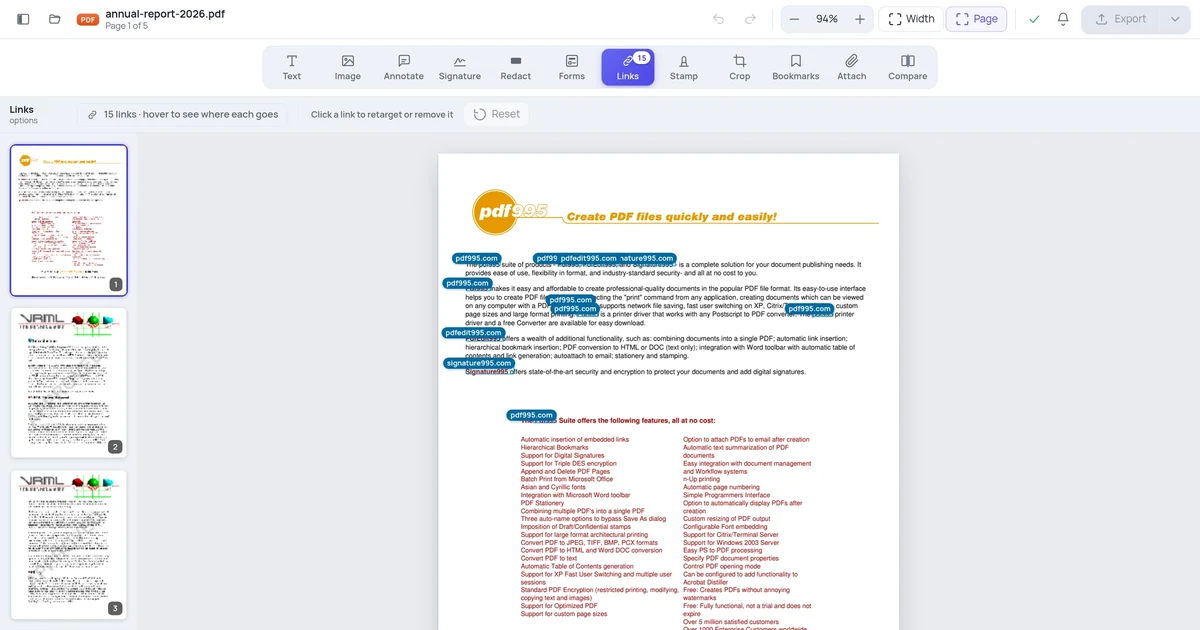
Metadata and hidden layers accumulate silently. Revision history, comments, thumbnails, XMP metadata, and digital signatures all add bytes. A heavily-reviewed contract can carry megabytes of version data that serves no purpose once the document is finalized.
Transparency effects and gradients in designed PDFs force the viewer to store complex rendering instructions rather than flat pixel data, adding file size without obvious visual output.
Understanding the source of the bloat tells you which compression approach to use — and how aggressive you can be without visible quality loss.
Email Attachment Limits by Provider
Most people assume the limit is "around 25MB." In practice, it is both lower and more complicated than that.
| Provider | Stated Limit | Practical Limit | Notes |
|---|---|---|---|
| Gmail | 25 MB | 12–18 MB | Base64 encoding inflates attachments ~33% in transit |
| Outlook / Hotmail | 20 MB | 15–18 MB | Lower than Gmail; enterprise accounts may be stricter |
| iCloud Mail | 20 MB | 20 MB | Uses Mail Drop for large files automatically above limit |
| Yahoo Mail | 25 MB | 20–22 MB | Encoding overhead still applies |
| Corporate Exchange | 10–20 MB | Varies | Set by IT admin; often lower than consumer providers |
| Web forms / portals | 5–10 MB | 5–10 MB | Job applications, legal portals, government forms |
The "practical limit" for Gmail deserves emphasis. When an email client encodes a binary attachment for SMTP transport, it uses Base64, which inflates the file by roughly 33%. A 20MB PDF attachment becomes a 26MB email, which Gmail rejects. This is why people hit Gmail's limit with a 19MB file and are confused.
If you are submitting to a web form — a job application portal, a government agency, a legal filing system — assume a 5MB cap unless stated otherwise. These systems are often stricter than email.
The safest target for any emailed PDF: under 10MB. That clears every provider's practical limit and leaves headroom for the email body and any other attachments.
How to Compress a PDF for Email
For most PDFs, compression takes under a minute and produces no visible difference in text quality.
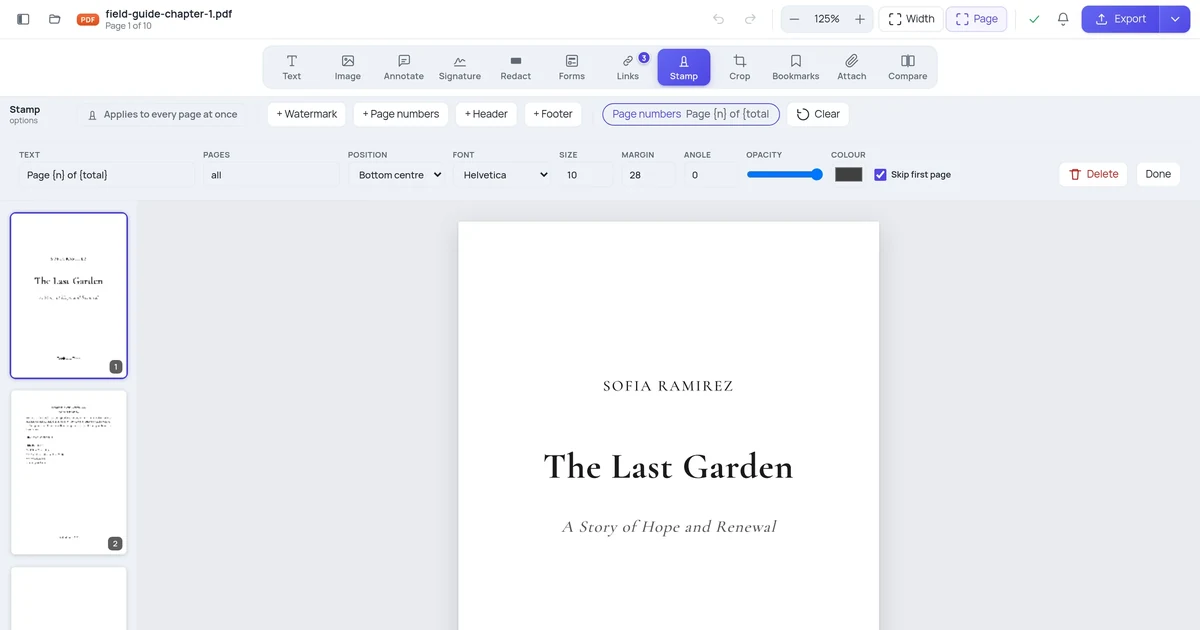
Use an online compressor for quick results. Tools like OnlinePDFEdits' compress PDF tool re-encode images at screen resolution (typically 96-150 DPI), strip embedded thumbnails, and flatten transparency — all without altering readable text. Text in PDFs is stored as vector outlines, not pixels, so it survives any compression level with perfect sharpness. The only visible change is in photographs and graphics, which are downsampled from print to screen resolution. For text-heavy PDFs like contracts, invoices, and reports, quality loss is effectively zero.
Step-by-step with OnlinePDFEdits:
- Go to onlinepdfedits.com/compress-pdf
- Upload your PDF (or drag and drop)
- Select compression level — "Standard" works for most email use cases
- Download the compressed file
A 15MB scanned report typically drops to 2-4MB. A 25MB design portfolio with embedded photos might go to 8-12MB. A text-heavy contract rarely needs compression at all, but if it does, it will drop 40-60% with zero perceptible change.
Check the result before sending. Open the compressed file and scroll through it. If any page looks noticeably blurry at normal reading zoom, re-export at a slightly lower compression level.
Manual Techniques When You Control the Source File
If you are generating the PDF yourself — from Word, InDesign, Google Docs, or another application — you have more options before the file is even created.
Reduce image resolution at export. In Word, go to File → Options → Advanced → Image Size and Quality, and enable "Compress images in file." When printing to PDF from any app, look for "Optimize for web/screen" rather than "Print quality." Screen resolution (96-150 DPI) is indistinguishable from print resolution on any monitor.
Flatten transparency. Transparency effects (drop shadows, opacity, blending modes) can be flattened to simple pixel data before export, which some PDF engines handle more efficiently. Adobe Acrobat's "Flatten Transparency" preflight can reduce file size meaningfully on design-heavy documents.
Remove embedded thumbnails and metadata. If you have Acrobat or Preview (Mac), you can strip document properties, XMP metadata, and page thumbnails — data a recipient never sees but which can add several megabytes to heavily-reviewed files.
Subset fonts, don't embed full sets. Most modern PDF exporters do this automatically, but if you are using an older application, confirm that font embedding is set to "Subset" (embed only used characters) rather than "Embed all."
Avoid scanning at high DPI unless required. For a document that will be read on screen, 150 DPI is sufficient. 300 DPI is for archival or print reproduction. 600 DPI is for OCR on very small text. Scanning a standard letter page at 600 DPI creates a file roughly 16 times larger than 150 DPI for no perceptible screen quality gain.
Also worth knowing: if your PDF has pages that aren't needed, removing them before compression will reduce the file size further. The delete pages tool handles this in the same workflow.
When Compression Is Not Enough
Some PDFs legitimately cannot be compressed below a useful threshold. A 200-page engineering drawing set with fine technical linework cannot be degraded to 5MB without losing critical detail. A legal discovery package with 500 scanned exhibits may simply be a large file by necessity.
In these cases, stop trying to email the file and use a transfer method designed for large files:
Cloud sharing links. Upload the PDF to Google Drive, Dropbox, or OneDrive and share a view-only link. The recipient gets the full-resolution original, the email is a few bytes long, and there is no attachment limit involved. This is also more secure — you can revoke access, track views, and avoid sending a permanent copy.
WeTransfer. Free up to 2GB per transfer, no account required for the sender. The recipient gets a download link valid for 7 days. Works well for one-off sends to people who don't use cloud storage.
Secure file-sharing portals. For legal, medical, or financial documents, purpose-built portals (Citrix ShareFile, DocSend, Box) provide access controls and audit trails that email cannot. If you are regularly emailing sensitive large PDFs, a portal is worth the overhead.
Split the document. If the file contains sections that make sense independently — chapters, monthly reports, individual exhibits — split it into smaller files and send multiple emails or zip them. The extract pages tool makes this straightforward.
One important note on security: before you compress and email any PDF, consider whether it should be password-protected. The 2023 Unit 42 Network Threat Trends Research Report from Palo Alto Networks found that PDFs accounted for 66.6% of malicious email attachments, making them the most common malicious attachment type. Encrypting a sensitive PDF before sending — using OnlinePDFEdits' encrypt tool or any equivalent — ensures only the intended recipient can open it, regardless of where the email ends up. See also: [/blog/pdf-wont-open-fix] if the recipient reports they cannot open your file after receiving it.
Preventing Large PDFs at Creation Time
The cheapest fix is the one you never have to do.
Export for screen, not print, by default. Unless someone will be printing your PDF at a professional print shop, "Screen" or "Web" quality at export produces a file 70-90% smaller than "Print" or "High Quality" with no visible difference on any monitor or phone screen.
Compress images before inserting them. If you are building a report in Word or Google Docs, resize photos to the display size you actually need before inserting them. A 4000×3000 pixel photo resized to 600×450 before insertion is 44 times fewer pixels to embed.
Use PDF/A only when required. PDF/A (archival format) embeds full font sets and color profiles, adding size. Use it only when archiving documents for long-term preservation or legal compliance.
Remove comments and tracked changes before final export. If a document went through multiple reviewers in Word or Google Docs, accept all changes and delete comments before saving to PDF. These annotation layers add up.
Merge multiple files thoughtfully. If you are combining several PDFs with the merge PDF tool, run compression on the merged result — combining files often duplicates embedded fonts and resources that a compression pass can consolidate.
Building these habits means most PDFs you send will clear email limits without any extra step.
FAQ
What is the maximum PDF size I can email with Gmail?
Gmail's stated limit is 25MB, but the practical limit is 12-18MB. Email clients encode binary attachments in Base64 format for transport, which inflates the file size by about 33%. A 20MB PDF attachment becomes roughly a 26MB email in transit — over Gmail's limit. To be safe, compress any PDF you are emailing via Gmail to under 15MB, and aim for under 10MB if the recipient might forward it.
Does compressing a PDF reduce text quality?
No. Text in a PDF is stored as vector outlines — mathematical descriptions of letter shapes — not as pixel images. Compression affects embedded photographs and graphics, not text. A compressed PDF will have the same sharp, scalable text as the original at every zoom level. Quality loss is only visible in photographs that were at very high resolution before compression, and even then it is usually imperceptible at normal reading sizes.
Why is my PDF so large when it only has a few pages?
Usually because the pages contain scanned images rather than native text. A single scanned page at 300 DPI is a high-resolution photograph with millions of pixels. Even a 3-page scanned form can easily be 10-15MB. The fix is compression: re-encoding those embedded images at screen resolution (96-150 DPI) dramatically reduces file size. If your PDF was created from a scan, you should expect compression ratios of 5:1 to 20:1 with no quality loss for everyday reading.
Is it safe to upload a confidential PDF to an online compressor?
It depends on the tool and how sensitive the document is. Reputable online tools process your file, return the result, and delete the uploaded copy — check the privacy policy to confirm deletion timing. For highly confidential documents (legal contracts, medical records, financial data), consider using a local desktop tool like Preview on Mac or Acrobat on Windows, which keeps the file entirely on your device. Alternatively, password-protect the PDF with OnlinePDFEdits' encryption tool before uploading it anywhere, so the content remains protected even if the file is temporarily stored on a server.