How to Add a Cover Page to a PDF
A practical guide to adding a cover page to a PDF, whether you build a new title page in an editor or merge a ready-made cover to the front of the file.

To add a cover page to a PDF, you have two routes. If your cover already exists as its own PDF or image, merge it to the front of your document so it becomes page one. If you don't have a cover yet, open the file in an online editor, insert a blank page at the start, and add your title, name, and date. Both take a couple of minutes. Pick the route that matches what you already have.
Key takeaways
- Two clean methods: merge a ready-made cover PDF to the front, or insert a blank first page and design the cover inside an editor.
- Position matters most. A cover page only works if it lands as page one, ahead of everything else.
- A cover is just a page. There's nothing special about the file format; it's a regular PDF page that happens to sit first and carry a title.
- Merging is fastest when your cover is already a separate file (a designed PDF, a scanned letterhead, or an image).
- Building it in-editor is best when you want to type the title directly and skip exporting from another app first.
- The usual snag is the cover ending up on page two, or a different page size that makes the cover look mismatched against the body.
What "a cover page" actually means in a PDF
A cover page is simply the first page of your document, the one a reader sees before any content. There is no special "cover" object in the PDF format; a cover is an ordinary page that you've arranged to sit at the front and dressed up with a title, a name, a date, maybe a logo. That's the whole trick.
Because it's just a page, you can produce it in two completely different ways, and which one is right depends on what you have on hand. If someone already handed you a polished title page, a branded letterhead, or an exported design from Canva or Word, that cover lives in its own file. The job then is to stick it onto the front of your document, which is a merge. If you have nothing yet and want to make the cover from scratch, the job is to add a blank page first and type onto it, which is an editing task. The rest of this guide walks through both.
Method 1: merge a ready-made cover to the front
This is the route to use when your cover already exists as a separate PDF (or an image you can drop in). It's the fastest path because you aren't designing anything, just ordering files.
- Get your cover into PDF form. If your title page is a Word doc, a PowerPoint slide, or a Canva design, export it to PDF first so you have a one-page cover file. An image (PNG or JPG) works too in most merge tools.
- Open the merge tool. Go to Merge PDF and upload two files: your cover page first, then the main document.
- Set the order. Drag the cover to the top of the list so it sits ahead of the body. Order in the list becomes order in the finished file, so the cover must be first.
- Merge and download. Combine the files and save the result. Your cover is now page one, and the original document follows it untouched.
That's the entire job. The body of your document keeps its formatting exactly; you've only added a page in front. If you ever need to do the reverse later, the same tool handles pulling pages apart again.
The catch: page sizes that don't match
Here's the snag nobody warns you about. If your cover was made at a different page size than your document, US Letter cover against an A4 body, say, the finished PDF will have two different page dimensions back to back. It still works, but it looks off: the cover might be slightly wider or taller than every page after it, and a viewer in two-page spread mode will line them up awkwardly.
The fix is to match sizes before you merge. Export your cover at the same page size as the document (check the body's size first, then set your cover app to match). If you've already merged and noticed the mismatch, it's usually easier to remake the cover at the right size and merge again than to rescale a page afterward. A quick way to check: open the merged file and glance at the page edges as you scroll from the cover into the body; any jump in width tells you the sizes differ.
Method 2: build the cover page inside the editor
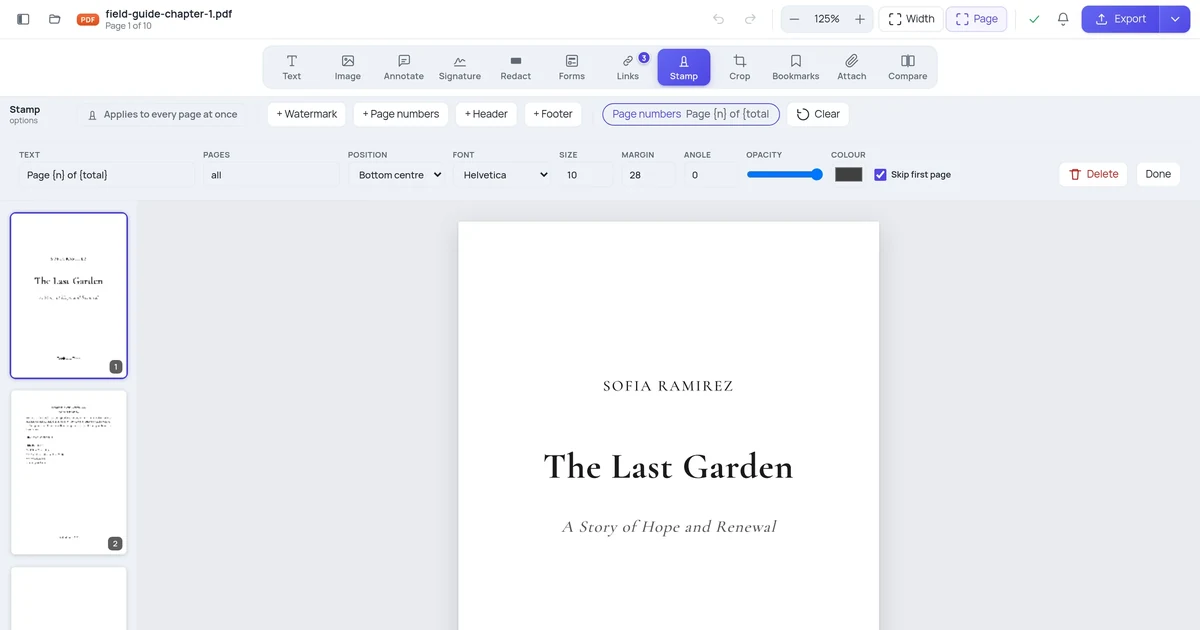
Use this route when you don't have a cover yet and want to make one without bouncing through another app. You add a blank page at the very start, then type your title onto it.
- Open your document in the editor. Upload the PDF you want to add a cover to. It opens in your browser ready to edit.
- Insert a blank page at the front. Add a new page and move it to position one, ahead of the current first page. Our walkthrough on inserting a blank page into a PDF covers this step in detail if you want the exact clicks.
- Add your title. Type the document title near the upper-middle of the page, set larger than body text so it reads as a heading.
- Add the supporting details. Underneath, add the author or organization name, a date, and anything else a cover needs, a subtitle, a version number, a confidentiality note.
- Drop in a logo or image (optional). If you have a logo, place it at the top or center it above the title. Keep it crisp; a small, sharp logo beats a large blurry one.
- Save and download. Export the file. Your typed cover travels with the PDF as its first page.
This route keeps everything in one place and is ideal when the cover is text-heavy, a report title page, a thesis cover, a proposal front sheet, where you'd rather type than design in a separate tool.
The catch: the cover lands on page two
The most common mistake with this method is a brand-new page that inserts after the current first page instead of before it. You end up with the old page one still in front, and your shiny cover sitting second. Always confirm the new page is at position one before you start typing. If it landed in the wrong spot, reorder it to the front, then add your title. Check the page count and the order one more time before exporting, it takes five seconds and saves a re-do.
Which method should you use?
Both produce the same result, a cover as page one, so the choice comes down to what you already have and how much design control you want.
| Situation | Best method | Why |
|---|---|---|
| Cover already exists as a PDF, slide, or image | Merge (Method 1) | No re-creating; just order and combine |
| No cover yet, mostly text (title, name, date) | Build in editor (Method 2) | Type directly, nothing to export first |
| Cover needs heavy graphics or brand layout | Design elsewhere, then merge | Design apps give finer layout control |
| You want one tool, one upload, one download | Build in editor (Method 2) | Everything happens in the same place |
| Cover and body are different page sizes | Merge, but match sizes first | Avoids the mismatched-edges look |
If you're combining several documents and also want a cover, merging handles both at once: upload the cover, then all the parts, set the order, and combine. And if you need to slip a cover into the middle of an existing combined file rather than the front, see inserting pages from another PDF at a specific spot, which covers precise placement.
Platform notes: phone, Mac, and Windows
The online routes above work the same in any browser, on a laptop or a phone, because the work happens on the server, not the device. A couple of platform-specific notes are still worth knowing:
- iPhone and iPad: You can build a cover in Pages or Keynote, export to PDF, then merge it onto your document in the browser. The Files app can also share a PDF straight into a web tool.
- Mac: Preview can reorder pages by dragging thumbnails, so if you've already merged a cover and it landed second, you can drag it to the front there. For making the cover itself, Pages exports a clean one-page PDF.
- Windows: There's no built-in PDF editor that reorders pages, so the browser route is usually the simplest. Word or PowerPoint can produce a cover, which you then export to PDF and merge.
- Android: Same browser flow as desktop. Google Docs or Slides can generate a cover, export to PDF, then merge.
Across all of them, the principle is identical: produce the cover, then either merge it to the front or insert it as a blank first page and type on it.
A worked example
Say you've written a 12-page project proposal but it has no title page. You want a cover with the project name, your name, the client's name, and the date. You don't have a cover file yet, so Method 2 fits. You open the proposal in the editor, insert a blank page and move it to position one, then type "Riverside Park Redesign Proposal" near the top, add "Prepared by Usama Ramzan" and "For Riverside City Council" beneath it, and put the date at the bottom. You drop your firm's logo above the title. Export, reopen, and confirm the cover is page one with the proposal starting on page two. Done in about three minutes, no second app needed.
Now suppose instead your designer already sent you a finished cover as cover.pdf. Method 1 is faster: open Merge PDF, upload cover.pdf first and the proposal second, drag the cover to the top, merge, download. Same outcome, less typing.
A note on privacy
Since you're uploading a document to make these changes, it's worth a plain-language note: an online editor processes your file on a server to merge or edit it, and files aren't kept long-term. That's normal for browser-based PDF work, but if your cover or document contains sensitive details, it's good to know before you upload.
FAQ
How do I add a cover page to a PDF?
Two ways. If you already have a cover as a separate PDF or image, merge it to the front of your document so it becomes page one, set the cover first in the order, then combine and download. If you don't have a cover yet, open the file in an online editor, insert a blank page at the start, and type your title, name, and date onto it. Both take only a few minutes.
Can I add a cover page without buying software?
Yes. An online PDF editor and merge tool let you do the whole job in a browser, no installation. To attach an existing cover, use a merge tool and put the cover first in the list. To make a cover from scratch, insert a blank first page and type onto it. Download the finished file when you're done; nothing needs to be purchased for either route.
How do I make sure the cover is page one and not page two?
Order is everything. When merging, drag the cover to the very top of the file list before combining, since list order becomes page order. When building a cover inside the editor, after inserting the blank page, confirm it sits at position one rather than slipping in after the current first page. Check the page count and the page order once more before you export.
Why does my cover page look a different size than the rest?
Because the cover was made at a different page size than the document, US Letter versus A4, for example. The merge still works, but the two sizes sit awkwardly back to back. Fix it by exporting your cover at the same page size as the body before merging. Check the document's page size first, set your cover app to match, then combine.
Can I add a cover that includes a logo or image?
Yes. If you're building the cover in the editor, place a logo or image directly onto the blank first page above or beside your title; keep it sharp, since a small crisp logo looks better than a large blurry one. If your cover is a fully designed graphic, export it as a one-page PDF (or use an image) and merge it to the front instead.