How to Add a Stamp to a PDF (Approved, Draft, Confidential)
A practical guide to adding a stamp to a PDF, like Approved, Draft, or Confidential, by placing styled text on the page, angling it, setting the color, and saving it into the file.

To add a stamp to a PDF, open the file in an online editor, click the Add Text tool, and click where you want the stamp. Type the word, like APPROVED, DRAFT, or CONFIDENTIAL, then make it bold, set a large size, color it red, and rotate it on a diagonal. Drag it into place and save to bake the stamp into the file. No installs needed.
Key takeaways
- A stamp is really styled text you place on top of the page, so you build it from the Add Text tool, set it bold and large, color it, and angle it, rather than hunting for a single "stamp" button.
- The classic look is uppercase, red, bold, and rotated roughly 30 to 45 degrees across the page, which is what reads instantly as a stamp rather than a normal line of text.
- Stamps work on any PDF, including scans, because you are floating new text over the page, not editing the existing words, so a locked or image-only document takes a stamp fine.
- Set the style before you fuss over position, since changing the size, weight, or rotation moves and resizes the stamp and undoes careful placement.
- A diagonal stamp can cover content you need to keep readable, so use a lighter or semi-transparent color, or place it in a margin, when the text underneath still has to be read.
- A stamp is visual, not a legal lock; "APPROVED" looks official but does not secure or sign the file, so pair it with a real signature or password when that matters.
What a PDF stamp actually is
Most people picture a stamp as a special object, like a rubber stamp tool you stamp once and you are done. In a browser-based editor, a stamp is simpler than that: it is a piece of text you add on top of the page and style to look stamped. The word APPROVED in bold red caps, rotated on a diagonal, is the stamp. There is no separate magic involved.
That matters because it tells you how to build any stamp you want. You are not limited to a fixed list of presets. APPROVED, DRAFT, CONFIDENTIAL, PAID, VOID, FINAL, FOR REVIEW, COPY, your department name, a date, all of them are the same job: add text, style it, angle it, place it. Once you can make one, you can make any of them.
It also explains why a stamp works on documents that resist editing. A PDF locks its existing text in place, but a stamp does not touch that text. You are layering a new object over the page, so even a scanned PDF, which is just an image with no selectable words, takes a stamp without complaint. You are stamping over the image, not into it.
How do I add a stamp to a PDF?
Here is the full path for a classic diagonal stamp using an online editor. You upload, add the text, style it to look stamped, angle it, and place it.
- Open your PDF in the editor. Go to the PDF editor and upload the file. Every page opens in your browser ready to work on.
- Select the Add Text tool. In the toolbar, click the text tool, often labeled Add Text or Text Box. Your cursor switches to text-placement mode.
- Click where the stamp should go. Click near the center of the page, or a top corner, depending on the look you want. A text box appears with a blinking cursor.
- Type the stamp word in caps. Type APPROVED, DRAFT, or CONFIDENTIAL. Uppercase reads as a stamp far better than mixed case.
- Make it bold and large. With the box selected, set a bold weight and bump the size up, commonly 40 to 72 point so it spans a good part of the page.
- Set the color. Open the color picker and choose red for the traditional stamp look, or another color that fits your purpose, like a muted gray for a subtle watermark feel.
- Rotate it on a diagonal. Use the rotation handle or angle control to turn the text roughly 30 to 45 degrees. That diagonal is what makes it read as a stamp.
- Drag it into position. Move the stamp so it sits where you want, centered over the content or tucked into a corner.
- Lower the opacity if it hides text. If the stamp covers words that still need to be read, drop its opacity so the page shows through.
- Save and download. Export the file. The stamp is written into the document and travels with it wherever it goes.
That is the whole task. The parts most guides skip are how to keep the stamp from burying the text underneath, and the difference between a stamp that looks official and one that actually secures the file. Those are next.
Building the three classic stamps
Approved, Draft, and Confidential each have a slightly different conventional look. Here is how people usually style them, though none of this is a rule, just what reads correctly at a glance.
| Stamp | Color | Style | Where it usually goes |
|---|---|---|---|
| APPROVED | Green or red | Bold caps, diagonal, with a date underneath if needed | Top-right corner or centered |
| DRAFT | Red or gray | Bold caps, large, diagonal across the page | Centered, often semi-transparent |
| CONFIDENTIAL | Red | Bold caps, can be smaller and repeated in header and footer | Top and bottom margins, or diagonal center |
A few choices make each one land:
- APPROVED often sits in a corner so it does not bury the content, sometimes with a date or initials added on a second line. Green says approved cleanly; red also works.
- DRAFT wants to be unmissable, so it goes big and diagonal across the middle, usually semi-transparent so the draft text underneath stays readable.
- CONFIDENTIAL sometimes runs as smaller bold text in the top and bottom margins of every page, which is the standard legal-document look, rather than one big diagonal.
If you are adding a date alongside the stamp, our guide on how to add a date or timestamp to a PDF covers placing the date cleanly so it lines up under the stamp word.
The catch: a diagonal stamp can bury the text underneath
Here is what trips people up. A big, bold, red stamp across the center of a page looks great, right up until you realize the paragraph it is sitting on is now half unreadable. The stamp is an opaque object floating on top of the page, so by default it blocks whatever is behind it. Nothing on the page moves aside to make room, because the page is fixed.
For a DRAFT or CONFIDENTIAL stamp that needs to span the page while the content stays legible, there are three fixes:
- Lower the opacity. Drop the stamp to something like 30 to 50 percent so the words show through. This is the watermark approach, and it is the most common solve for a centered diagonal stamp.
- Move it to a margin. Place APPROVED in the top-right corner or run CONFIDENTIAL along the top and bottom edges where there is no body text to cover.
- Shrink it. A smaller stamp in a clear area says the same thing without competing with the content.
If the stamp is the point, like a giant VOID across a cancelled invoice, then covering the content is fine and even desirable. The trade-off only matters when the page underneath still needs to be read.
Add the stamp once or to every page
A single APPROVED on the cover page is one placement. CONFIDENTIAL on a fifty-page report is a different ask, because the convention is for it to appear on every page.
There is no universal one-click "apply to all pages" in every editor, so plan for one of these:
- Place it once per page if you only have a handful of pages. Tedious but precise, and you can vary the position if a page has no room in the usual spot.
- Copy and paste the stamp across pages if your editor supports copying an element, which keeps the style identical and just needs repositioning.
- Use a header or footer feature for text-style CONFIDENTIAL marks, since header and footer tools are built to repeat the same text on every page automatically.
For a true repeated watermark across a long document, the header and footer route or a dedicated watermark tool is cleaner than hand-placing a stamp dozens of times. For a one-off APPROVED on a contract, manual placement is faster than setting anything up.
A stamp is visual, not a legal lock
This is the honest caveat. A stamp that says APPROVED looks official, but it is just colored text on the page. It does not sign the document, it does not prove who applied it, and anyone with an editor can add the same word to any file. Treat a stamp as a visual label, not as security.
When the stamp needs to carry weight, pair it with the real mechanism:
- For approval that should be attributable, add an actual signature alongside the stamp, or use a signing flow that records who signed and when.
- For confidentiality that should be enforced, a CONFIDENTIAL stamp is a reminder, not a barrier. If the file genuinely must be protected, set a password so it cannot be opened or copied freely.
- For a draft you do not want mistaken for final, the stamp plus a clear filename like report-DRAFT.pdf does more than the stamp alone.
A checkmark next to an approval line is a related touch people often want; our guide on how to add a checkmark or tick mark to a PDF covers placing one cleanly next to a stamp or a form line.
Adding a stamp on different devices
The idea is the same everywhere, build a stamp from styled text, but the tooling and how well it survives differ.
| Platform | How you add a stamp | Notes |
|---|---|---|
| Online (any browser) | Open the PDF editor, add text, set bold, color, size, and rotation | Works on desktop and mobile browsers; full control over angle and opacity; nothing to install |
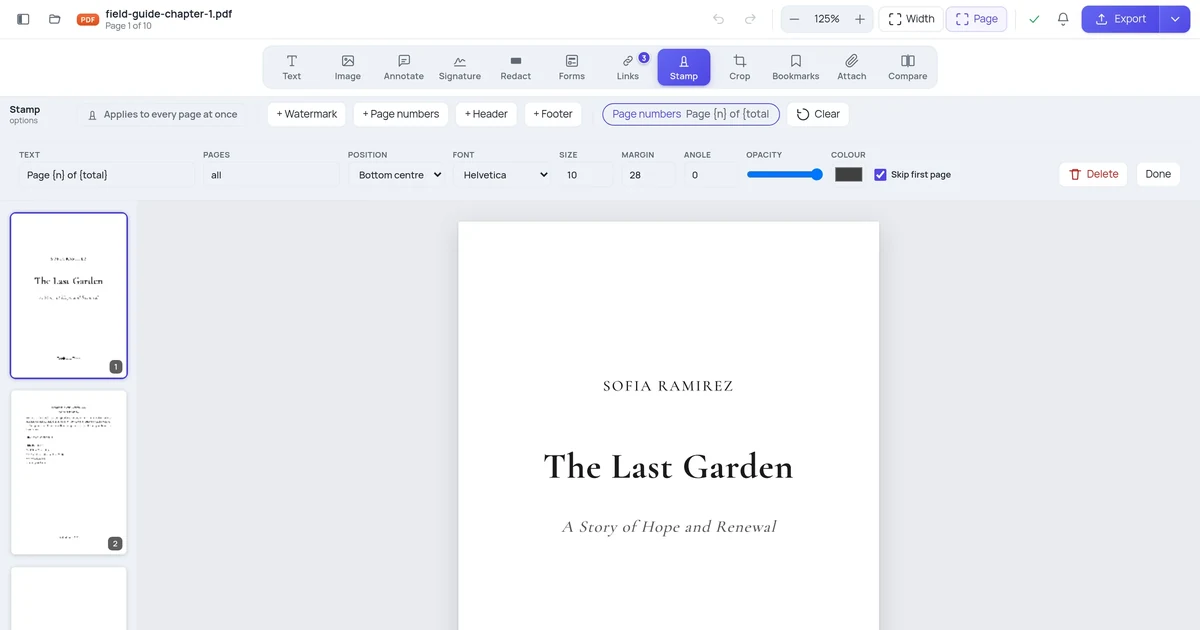
| Windows (desktop app) | A PDF editor's Stamp tool, or Add Text and style it | Paid editors often ship preset stamps; free readers may only add comment-style notes |
| Mac (Preview) | Markup toolbar, Text button, then style and rotate | Workable for a corner stamp; rotation and opacity are limited |
| iPhone / iPad | Markup in Files or Books, text annotation | Fine for a quick corner stamp; precise angling and opacity are fiddly |
| Android | A PDF app with annotation or stamp tools | Quality varies a lot; confirm the stamp actually saves into the file |
The common gotcha across phones and free desktop readers: what looks like a stamp is sometimes added as a comment or annotation, which can render differently or even get stripped when the file is opened elsewhere. If the recipient must see APPROVED exactly where you put it, add it as real content and confirm by reopening the saved file. The online route writes the stamp into the document on export, so it stays put.
A worked example
Say you are signing off on a one-page purchase order and the requester needs to see it is approved. You open the file in the PDF editor, pick the Add Text tool, and click in the top-right corner above the line items. You type APPROVED, set it bold, bump it to 48 point, and color it green. You rotate it about 30 degrees so it reads as a stamp, not a heading, then nudge it so it clears the order number. On a second short line under it you add the date so there is a record of when. The line items below are untouched because the stamp only sits on empty corner space. You download the file, reopen it to confirm the stamp saved exactly where you placed it, and send it back. If the approval needed to be attributable, you would add a signature too, since the stamp alone is just a label.
FAQ
How do I add a stamp to a PDF?
Open the PDF in an online editor, select the Add Text tool, and click where you want the stamp. Type the word in caps, like APPROVED, DRAFT, or CONFIDENTIAL, then make it bold, set a large size, and color it red. Rotate it about 30 to 45 degrees so it reads as a stamp, drag it into position, and lower the opacity if it covers text you need to read. Save and download to write the stamp into the file. It works on scanned PDFs too, since you are adding text on top, not editing the page.
How do I make a stamp look like a real rubber stamp?
The look comes from a few choices together: uppercase text, a bold weight, a large size, a red color, and a diagonal rotation of roughly 30 to 45 degrees. That combination is what the eye reads as a stamp rather than ordinary text. Adding a thin border around the word, or a date on a second line, pushes it further toward the rubber-stamp feel. Keep the color saturated and the angle consistent across pages if you are stamping more than one.
Can I add a stamp to a scanned PDF?
Yes. A scanned PDF is an image of a page with no selectable text, but a stamp does not touch the image, it floats new styled text on top. So you can drop APPROVED, DRAFT, or CONFIDENTIAL anywhere on a scan and it saves into the file normally. The only thing you cannot do is edit the words inside the scan, because they are pixels, not text. For stamping, though, a scan behaves exactly like any other PDF.
Does adding an "Approved" stamp make the document legally signed?
No. A stamp is colored text on the page, nothing more. It looks official, but it does not record who applied it or prove the file was not changed afterward, and anyone with an editor can add the same word. For an approval that needs to hold up, pair the stamp with an actual signature or a signing flow that captures identity and time. For confidentiality, a CONFIDENTIAL stamp is a reminder, not protection; set a password if the file genuinely must be secured.
How do I put a Confidential stamp on every page?
For a few pages, place the stamp once on each, or copy and paste the styled stamp across pages so the look stays identical and you only reposition it. For a long document, a header or footer feature is cleaner, since it repeats the same text on every page automatically, which is the standard way CONFIDENTIAL runs in the top or bottom margin of legal files. For a big diagonal watermark across many pages, a dedicated watermark tool beats hand-placing the stamp dozens of times.