How to Invert PDF Colors for Easier Night Reading
A practical guide to inverting PDF colors for night reading, with view-only options that spare your eyes and a saved dark-mode file that keeps the look everywhere.

To invert PDF colors for night reading, you have two routes. For a quick, reversible flip, turn on your reader's "Invert" or dark-mode setting so black text shows as white on a dark background, viewed only on your screen. To bake the inverted look into the file itself, open it in an online editor, apply a color-inversion effect, then save and download. The first is instant; the second is permanent.
Key takeaways
- Inverting flips every color to its opposite, so black text becomes white and a white page becomes black, which is the classic night-reading look that reduces glare in a dark room.
- A view-only invert is reversible and instant, built into Acrobat, Preview, and your phone, and it never changes the actual file.
- A saved inverted file keeps the dark look everywhere, so it appears the same when emailed, reopened, or printed, which a screen-only flip cannot do.
- Inverting also flips photos and logos, turning a portrait into a ghostly negative, so a true dark mode PDF is best for text-heavy documents.
- For e-ink readers and printing, converting to grayscale or black and white is often the better call than a full invert.
- No install needed for the basic job; a browser-based editor handles the permanent version on any device.
What "inverting colors" actually does
Inverting colors replaces every pixel with its exact opposite on the color wheel. White becomes black, black becomes white, and a mid-gray stays roughly mid-gray. For a typical document, that means a white page with black text turns into a black page with white text, which is exactly the high-contrast, low-glare effect that makes reading in a dark room far easier on your eyes.
This is different from a softer "dark mode" that some apps apply, where the background goes dark gray and the text stays a comfortable off-white without flipping images. A literal invert is a full negative of the page. That distinction matters because of what happens to anything that is not plain text, which we will get to. For a long novel, a research paper, or a contract you are reading at midnight, inverting is genuinely restful. The blast of a bright white page in a dark bedroom is the thing you are trying to escape, and a black page with light text fixes it immediately.
There are two ways to get there, and choosing the right one saves you a lot of frustration.
How do I make a PDF dark background?
The fastest way to a dark background is a view-only invert in whatever you are already reading with. Nothing is saved, nothing is changed in the file, and you can switch it off the moment you are back in daylight. Here is where the control lives on each platform.
- Adobe Acrobat / Reader (desktop). Open Preferences, go to Accessibility, tick "Replace Document Colors," and choose a custom scheme with a black page background and white text. This flips the display for every PDF you open until you turn it back off.
- Apple Preview / macOS (system-wide). Open System Settings, go to Accessibility, then Display, and turn on "Invert colors" (or Smart Invert). The whole screen inverts, so the PDF goes white-on-black along with everything else.
- iPhone / iPad. Settings, Accessibility, Display & Text Size, then "Smart Invert." Smart Invert leaves images and media mostly alone, which is exactly what you want for night reading. Classic Invert flips everything, photos included.
- Android. Settings, Accessibility, then "Color inversion" (sometimes under Visibility enhancements). Toggle it on for a system-wide flip; many e-reader and PDF apps also have their own night-mode toggle that only affects the document.
- Browser viewers. Chrome and Edge do not invert PDFs natively, but a reputable dark-mode browser extension can flip the page on screen. This is screen-only and never alters the file.
For pure night reading where you just want relief right now, the view-only invert is almost always the smarter choice. It is reversible, it is free, and it does not touch your original document. The trade-off is that the dark look exists only on your screen, in this session, on this device.
Saving a permanently inverted PDF
Sometimes a screen-only flip is not enough. Maybe you want to send a dark-themed reading copy to someone else, keep a presentation deck that is dark by design, or guarantee the document looks the same on a device you cannot configure. In those cases you want the inverted colors written into the file.
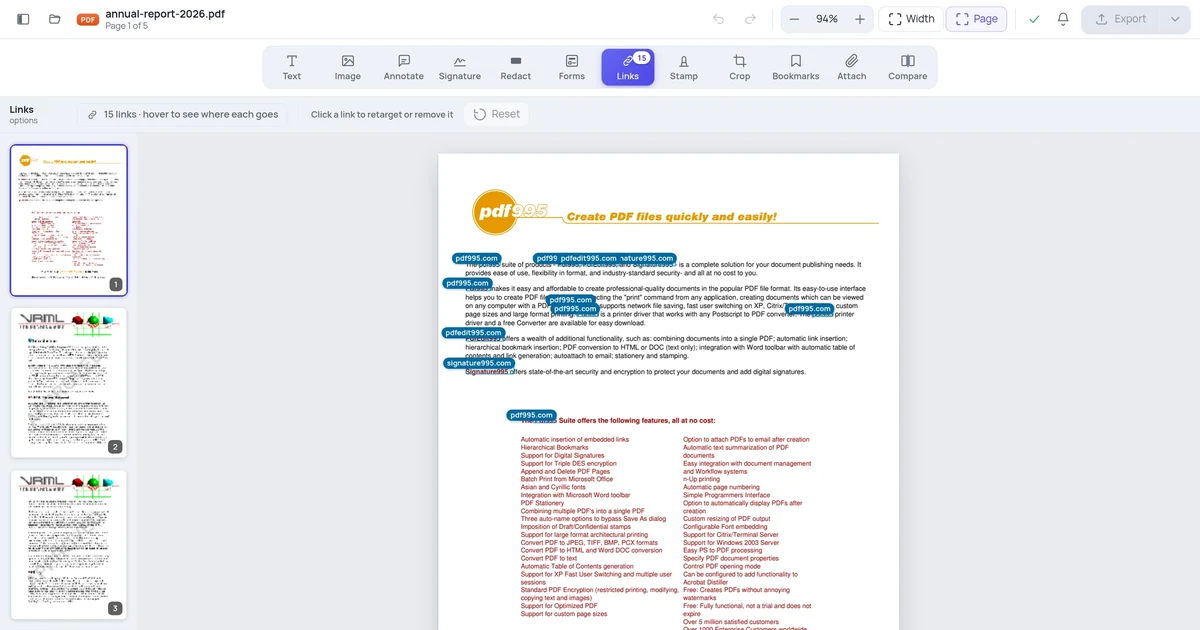
- Open your PDF in the editor. Go to the PDF editor and upload the file. It opens in your browser with every page visible.
- Apply a color effect to the page. Use the editor's color or filter controls to apply an inversion, or place a full-page black layer behind white-recolored text. The goal is white-on-black baked into the page rather than only on your screen.
- Check each page. Inversion applies per page, so scroll through and confirm none were missed, especially cover pages or section dividers that may use different backgrounds.
- Review images and logos. This is the step people skip. Photographs and colored logos will appear as negatives. Decide whether to leave them, or to mask and restore them individually.
- Save and download. Export the file. The dark look is now part of the document and travels with it when you email, reopen, or print.
The honest caveat: baking an invert into the file is heavier-handed than a view toggle, and it is genuinely useful only when the look has to persist beyond your own screen. If all you want is comfortable reading tonight, use the reversible view-only method above and leave your file untouched.
The catch: inverting turns your photos into negatives
This is the part nobody warns you about, and it is the single biggest reason a "just invert it" plan goes sideways.
A literal color invert does not know the difference between body text and a family photo. It flips every pixel the same way. So while your black text becomes crisp white text, a photograph becomes an eerie photographic negative, a blue corporate logo turns orange, a green chart turns magenta, and a portrait of a person looks like an X-ray. On a text-only document this is invisible because there is nothing but text and a background. On a brochure, a report with charts, or anything with embedded images, the result can be unusable.
This is exactly why Apple's "Smart Invert" exists: it flips the interface and text but tries to detect and skip images, so photos stay normal while the page goes dark. If you only have the classic, everything-flips invert available, the practical answer for an image-heavy file is to use a proper dark-mode approach rather than a raw negative.
| Document type | Best night-reading approach | Why |
|---|---|---|
| Plain text (novel, contract, paper) | Full invert, view or saved | Nothing but text, so flipping is clean white-on-black |
| Report with charts and a few images | Smart Invert (view-only) | Keeps photos and chart colors readable while darkening the page |
| Brochure or magazine layout | Dark-mode app, not a raw invert | A full negative ruins the imagery and brand colors |
| Scanned document | Invert works, but check contrast | Scans can go muddy; a grayscale pass may read better |
Platform variations at a glance
You can darken a PDF on any device, but the controls and the permanence differ. Here is the practical summary.
| Platform | How | Permanent? | Skips images? |
|---|---|---|---|
| Online editor (any device) | Upload, apply inversion, download | Yes | Only if you mask images manually |
| Adobe Acrobat (desktop) | Accessibility, Replace Document Colors | No (view only) | Yes, text/background only |
| macOS | Accessibility, Invert / Smart Invert | No (view only) | Smart Invert tries to |
| iPhone / iPad | Settings, Accessibility, Smart Invert | No (view only) | Smart Invert: yes |
| Android | Settings, Accessibility, Color inversion | No (view only) | Classic invert: no |
The pattern is clear: every built-in option is a reversible, screen-only flip, which is perfect for reading and useless for sharing a dark file. Smart Invert on Apple and many dedicated reader apps are the most comfortable for night reading because they spare your images. Only an editor produces a file that stays dark for everyone, and even then you handle the image problem yourself.
When a different approach beats inverting
Inverting is the right tool for one job: making bright text comfortable to read in the dark. It is the wrong tool for a few neighboring problems people bring to it.
If your aim is a polished, shareable dark theme rather than a literal negative, a true dark mode PDF setup on Android and iPhone gives you a dark page with readable text and undamaged images, which is what most people actually picture when they say "dark mode."
If you are reading on an e-ink Kindle or Kobo, those screens are reflective rather than backlit, so a black background does not save your eyes the way it does on a glowing phone, and large black areas can actually look worse. For e-ink, leaving the document as is, or converting it to clean grayscale or black and white, usually reads better than a full invert.
And if you intend to print, never invert first. Printing a black page wastes an enormous amount of toner and looks terrible on paper. Keep the original for printing and use the dark look only on screen.
A quick word on privacy, since saving an inverted copy means uploading the document. An online editor processes your file on a server to apply the effect, and files are not kept long-term. That is normal for browser-based editing, but worth knowing before you upload anything sensitive.
A worked example
Say you are reading a 40-page PDF of a public-domain novel in bed and the white pages are searing your eyes. There are no images, just text. You do not want to alter the file, so you reach for the view-only route: on your iPhone you open Settings, Accessibility, Display & Text Size, and flip on Smart Invert. Instantly the page is black with clean white text, the file itself unchanged, and you can switch it back in the morning with one tap. Now suppose a friend asks for that same dark reading copy to keep. This time you open the PDF editor, upload the file, apply the inversion so white-on-black is baked into every page, scan through to confirm no page was missed, and download. Because the novel is text-only, there are no photos to turn into negatives, so the saved file looks exactly like the comfortable view you were reading, and it stays dark for your friend on any device.
FAQ
How do I make a PDF dark background?
The quickest way is a view-only flip in your reader or system settings: turn on Invert or Smart Invert so the white page shows as black with white text, viewed only on your screen and reversible anytime. To make the dark background permanent, open the PDF in an online editor, apply a color inversion or place white text on a black page, then save and download. The saved version keeps the dark look when shared or reopened.
Will inverting colors ruin the images in my PDF?
With a literal invert, yes: photos become negatives, logos change color, and charts can look wrong, because every pixel flips equally. For documents with images, use Apple's Smart Invert or a dedicated dark-mode reader, which darken the page while leaving images alone. A raw invert is only safe on text-only files. If you must bake an invert into an image-heavy file, mask and restore each photo individually in the editor.
Is there a difference between invert and dark mode?
Yes. Inverting is a literal negative, flipping every color to its opposite, so it can be harsh on images. Dark mode is a designed look, a dark background with comfortably readable text, that usually leaves photos and brand colors intact. For pure text, the two look similar. For anything with images, a proper dark mode is gentler and more usable than a full color inversion.
Can I invert PDF colors on my phone for free?
Yes, on both platforms. On iPhone, go to Settings, Accessibility, Display & Text Size, and turn on Smart Invert, which spares images. On Android, open Settings, Accessibility, and switch on Color inversion, or use a reader app's built-in night mode. These are free, built-in, view-only flips, so the file stays unchanged and you can toggle the effect off whenever you like.
Should I invert a PDF before printing it at night?
No. A view-only invert never affects printing, but a saved inverted file will print as a black page, which wastes huge amounts of toner and looks poor on paper. Always print from the original, non-inverted version. Use the dark, inverted look strictly for on-screen reading. If you need an ink-light print version instead, convert the file to grayscale or black and white rather than inverting it.