How to Add a Table of Contents to a PDF
A step-by-step guide to adding a table of contents to a PDF, including how to make it clickable so readers jump straight to any section.

To add a table of contents to a PDF, open the file in an online editor, insert a new page near the front, and type each section title beside the page it starts on. To make it clickable, turn each line into a link pointing to the matching page so readers jump straight there in one tap. Most documents take only a few minutes.
Key takeaways
- A table of contents (TOC) is a list of section titles paired with the page each one begins on, placed near the front of the document.
- You build one in a PDF editor by adding a page, typing the titles and page numbers, then linking each line to its destination.
- A clickable TOC uses links, so tapping a title scrolls the reader straight to that section.
- The most common mistake is wrong page numbers, which happens when you add, remove, or reorder pages after building the list.
- Bookmarks and a TOC solve related problems and work well together in long files.
What a table of contents actually is in a PDF
A table of contents is a navigation page. On the left you list the names of your chapters or sections; on the right you list the page each one begins on. In a printed booklet that is enough, because the reader flips to the page themselves. In a PDF you can do better: each entry can be clickable, so a tap or click carries the reader directly to that section.
It helps to separate two things that often get confused. The visible TOC is the page your reader sees and reads. Bookmarks are the collapsible outline that appears in the side panel of most PDF viewers. They serve a similar purpose but live in different places. A polished long document often has both, and you can build them side by side.
PDF has supported internal links and outlines since its early days. The format was created by Adobe in the early 1990s under John Warnock's "Camelot" project, with PDF 1.0 arriving in 1993, and it became the open ISO 32000-1 standard in 2008. Clickable navigation has been part of the format throughout, which is why a TOC you build today works in virtually any modern viewer, on desktop or phone.
How do I add a table of contents to a PDF?
Here is the straightforward path using an online editor. You upload your file, build the TOC page, and download the result. No special software to install.
- Open your PDF in the editor. Go to the PDF editor and upload the file you want to add a contents page to. It opens in your browser, ready to edit.
- Find your section starting pages first. Scroll through the document and note where each major section begins. Write these down before you build anything, because the page numbers are the part most likely to go wrong. A quick list on paper or in a notes app is fine.
- Add a blank page near the front. Insert a new page right after the cover or title page. This becomes your contents page. Adding it at the front keeps the rest of the document in order.
- Add a heading. Type "Contents" or "Table of Contents" at the top, a little larger than the body text, so it reads clearly as a title.
- Type each entry. On its own line, write the section name on the left, then the page number where that section starts. A classic style is the title, a row of dots (a "leader"), then the page number, but a simple title-then-number layout is perfectly clear.
- Line up the page numbers. Keep the numbers aligned down the right edge so the page looks tidy. Consistent spacing does most of the visual work, and it makes the list far easier to scan.
- Save and download. When every line matches your document, export the file. Your new contents page travels with the PDF wherever it goes.
That gives you a clean, readable table of contents. If you want readers to jump to each section instead of scrolling, add links in the next step.
How to add a clickable table of contents to a PDF
A clickable TOC turns each line into a link. The reader taps "Chapter 3" and the viewer scrolls to page 24 on its own. This is the version people usually want for reports, manuals, and ebooks, and it is the difference between a contents page that merely informs and one that actually navigates.
- Build the plain TOC first, following the steps above. Get every title and page number correct before you add a single link. Fixing a typo is easier than fixing a typo and a broken link.
- Select the first entry. Highlight the text of one line, for example "Introduction." Selecting just that line keeps the link tied to the right words.
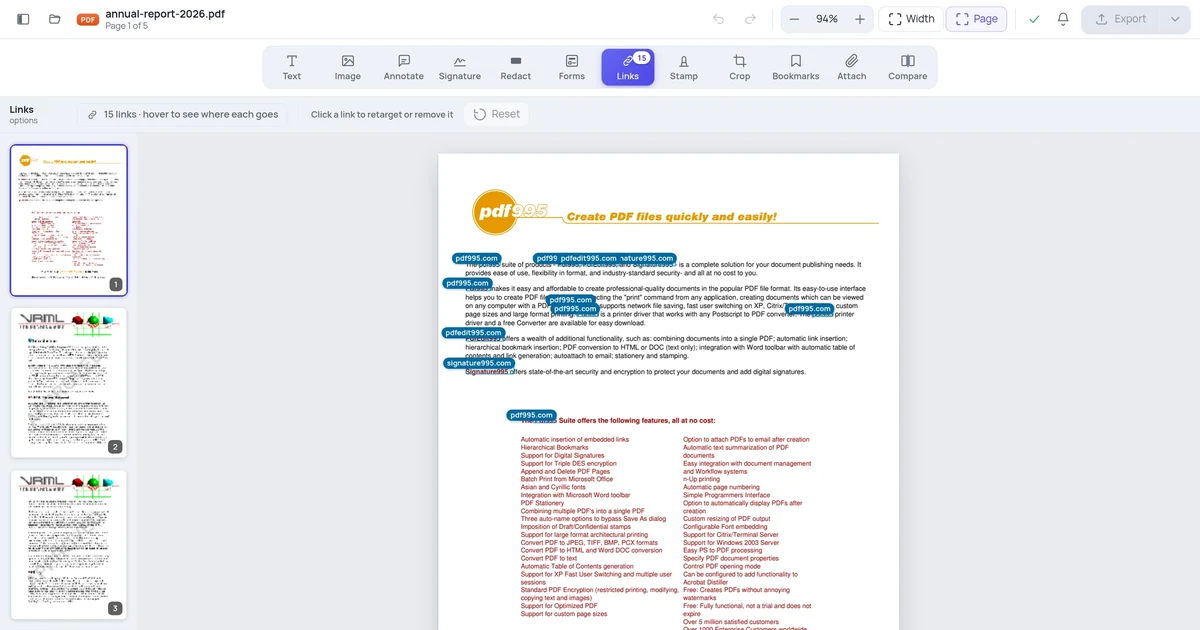
- Add a link to its page. Use the link tool and set the destination to the page where that section starts. That line is now a live jump point.
- Repeat for every entry. Work down the list one line at a time, linking each title to its matching page. Doing them in order makes it easy to spot one you missed.
- Test every link. Save the file, reopen it, and click each entry. Confirm it lands on the right section, not a page above or below.
A small but important tip: test the links in an actual PDF viewer, not only in the editor preview. Some viewers handle internal links slightly differently, and a quick pass catches anything odd before you send the file out. This is the step most people skip, and it is where surprises hide.
If you also want pages labeled clearly so the numbers in your TOC match what readers see, it is worth controlling how the pages are numbered. Our guide on numbering PDF pages from a specific page is handy when your front matter (cover, title page) shouldn't count toward the printed page numbers.
The realistic failure mode: page numbers drift
Here is the thing that breaks more TOCs than anything else, and it is worth understanding so you can avoid it entirely.
Your table of contents is a snapshot. It records where each section sat at the moment you built it. If you later insert a page, delete one, or reorder sections, every entry below that change now points at the wrong place. The TOC still looks perfect, but "Chapter 4, page 30" might actually start on page 31. Clickable links can drift the same way if the page they target moves, except the breakage is silent: the link still works, it just lands a page off.
The fix is simple discipline: finalize the document layout before you build the TOC. Add your contents page and links last, once you're confident no more pages will move. If you do have to edit afterward, walk through the TOC again, correct any numbers that shifted, and re-test each link. There is no automatic re-sync when you hand-build a TOC, so a final review is your safeguard. Treat the contents page as the last thing you touch, not the first.
This is also why many people pair a TOC with bookmarks. Bookmarks point to a location in the document rather than a printed number, so they tend to be a little more forgiving when pages shift, and they give readers a second way to navigate.
A worked example
Say you have a 40-page handbook with five sections. You scroll through and note: Welcome starts on page 2, Getting Started on page 6, Account Settings on page 14, Troubleshooting on page 27, and Contact on page 38. You insert a blank page after the cover, which pushes everything back by one, so your real numbers become 3, 7, 15, 28, and 39. (This off-by-one is exactly the kind of drift to watch for: adding the contents page itself shifts the document.) You type the five titles with those corrected numbers, align them on the right, then link each line to the page it names. Reopen the file, click "Troubleshooting," and confirm it lands on page 28. Five lines, five links, done.
When a TOC isn't the best tool
A full contents page earns its place in long documents: manuals, reports, contracts, ebooks, anything past a handful of pages. For a short three-page memo it can feel like overkill.
For shorter files, or files people mostly read in a viewer's side panel, bookmarks alone may be the cleaner choice. They don't take up a page, they're always one click away in the outline panel, and they don't interrupt the visual flow of the document. Many polished PDFs use both: a printed contents page for readers who print or skim front-to-back, and bookmarks for readers navigating on screen.
A quick word on privacy, since you're uploading a document. An online editor processes your file on a server to make these changes, and files aren't kept long-term. That's normal for browser-based editing, but it's worth knowing before you upload anything sensitive.
A few finishing touches
Small details make a TOC feel professional:
- Match the document's fonts. Use the same typeface as your headings so the contents page belongs to the document instead of looking pasted in.
- Group by level. Indent sub-sections slightly under their parent section. The reader instantly understands the hierarchy.
- Keep titles short. Trim long section names to a readable length. The TOC is a map, not the territory.
- Leave breathing room. A little space between entries makes a long list far easier to scan.
- Use a clear heading. A bold "Contents" line at the top, set off from the entries, tells readers exactly what they're looking at.
None of these are required, but together they turn a functional list into a contents page that looks designed on purpose.
FAQ
How do I add a table of contents to a PDF?
Open the PDF in an online editor, insert a blank page near the front, and type each section title next to the page where it begins. Add a clear "Contents" heading, line up the page numbers, then save and download. To make it clickable, turn each line into a link that points to its section's page.
How do I make my PDF table of contents clickable?
Build the plain list first, then highlight each entry and attach a link that targets the page where that section starts. Repeat for every line, then reopen the file and click each one to confirm it lands on the correct section. Testing in a real PDF viewer, not just the editor preview, is the step people skip.
What's the difference between a table of contents and bookmarks?
A table of contents is a visible page inside the document that readers see and read. Bookmarks are the collapsible outline that appears in a viewer's side panel. They do similar jobs in different places, and long documents often include both for the best navigation.
Why are my table of contents page numbers wrong?
Almost always because the document changed after you built the TOC. Inserting, deleting, or reordering pages shifts everything below, but the hand-typed contents page doesn't update itself. Finalize your page layout first, build the TOC last, and re-check the numbers if you edit afterward.
Can I add a table of contents without buying software?
Yes. An online PDF editor lets you add a contents page, type your entries, and create clickable links right in the browser, then download the finished file. There's nothing to install for the basic task.
Where should the table of contents page go?
Place it near the front, typically right after the cover or title page and before the main content begins. That's where readers expect to find it. If you don't want the front matter counted in your page numbering, adjusting where numbering starts keeps the TOC numbers matching what readers see.