How to Number PDF Pages Starting From a Specific Page
A step-by-step guide to numbering a PDF from a chosen page, so the cover and front matter stay clean while the numbers start exactly where you want.

To number PDF pages starting from a specific page, open the file in an online editor, leave the cover and any front matter without numbers, then add a page number to the first page you want counted and continue forward. Set that page's visible number to 1 so the printed numbering matches what readers expect, even though it sits later in the file. Most documents take a few minutes.
Key takeaways
- Two numbers are involved: the file's physical position (page 3 of the PDF) and the printed number you stamp on it (which can read "1"). The trick is keeping them deliberately out of sync.
- Skip the front matter by simply not stamping it. A cover page, title page, or blank shouldn't carry a number, so you start adding numbers on the first real content page.
- Decide your starting value before you stamp. The first numbered page can show 1, or continue from a higher number if it follows another document.
- The common failure is an off-by-one count, where the printed numbers don't line up with the file's actual pages after you skip a few.
- Hand-stamping doesn't auto-update. If you add or remove pages later, the numbers below the change need a manual pass.
- For a plain "number every page" job, a dedicated numbering flow is faster than placing each number by hand.
The two kinds of "page number" you're juggling
Before any steps, it helps to name the thing that trips people up. Every page in a PDF has a physical position: it's the 1st, 2nd, 3rd sheet in the file, and nothing changes that. Separately, there's the printed page number, the little "12" you see in the footer. People assume those two always match. They don't have to, and the whole point of this task is to break that assumption on purpose.
When you want numbering to start later, you're saying: "the cover is physically page 1 of the file, but it should carry no printed number, and the page that is physically page 3 should display 1." That gap, physical position minus printed number, stays constant once you set it. Hold that idea and the rest is straightforward.
This is exactly how books work. Open almost any paperback and the cover, title page, and copyright page carry no numbers; printed page 1 is several leaves in. PDF inherited that convention, and a good editor lets you reproduce it.
How do I number PDF pages from a specific page?
Here's the hands-on path using an online editor. You upload the file, decide where numbering begins, and stamp from there forward.
- Open your PDF in the editor. Go to the PDF editor and upload the file. It opens in your browser, ready to edit, with every page visible so you can see what should and shouldn't be numbered.
- Identify your front matter first. Scroll to the top and decide which leading pages get no number: usually the cover, sometimes a title page or a blank. Note the first page that should carry a number, for example the physical 3rd page.
- Decide the starting value. Most often the first numbered page shows 1. If this PDF continues another document, you might start at, say, 15 instead. Write down the value before you stamp anything.
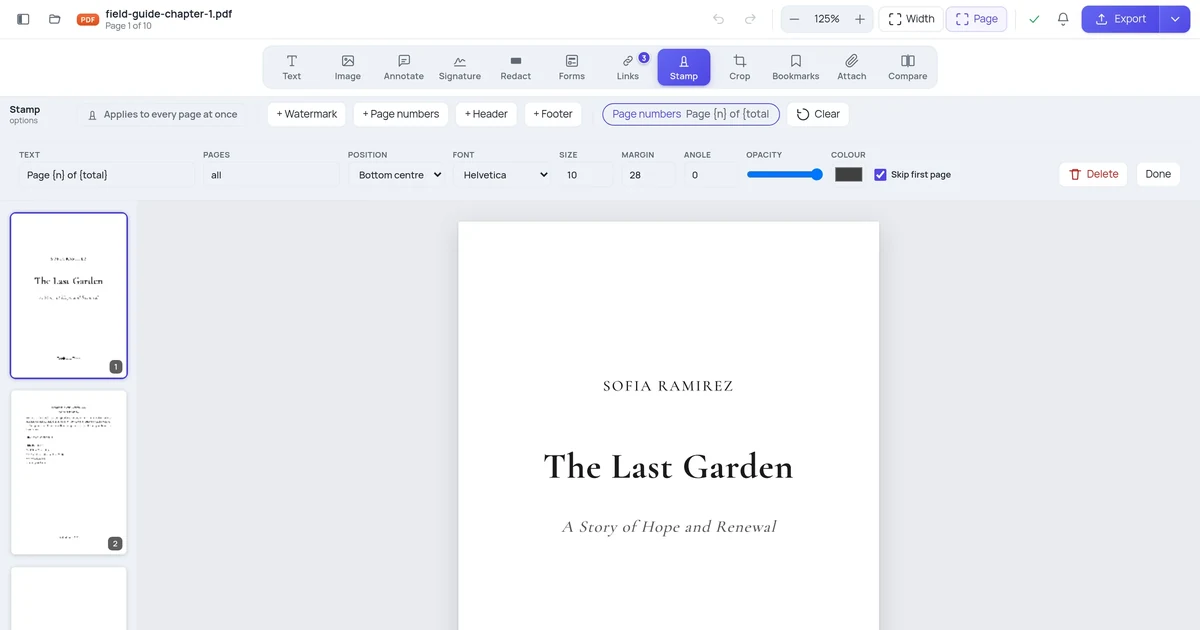
- Add the number to the first content page. On that page's footer (or header), insert a text element with your starting value. Place it where you want every later number to sit, commonly the bottom centre or bottom outer corner.
- Continue forward, one page at a time. Move to the next page and add the next number, then the next. Keep the position identical on each page so the footer looks anchored as readers flip through.
- Leave the front matter untouched. Don't go back and number the cover. The absence of a number is the formatting you want there.
- Save and download. Once every content page is stamped and the front matter is clean, export the file. The numbering travels with the PDF wherever it goes.
That gives you a document whose printed numbers begin exactly where you chose. If you simply want every page numbered with no skipping, the faster route is covered in our guide to adding page numbers to a PDF online for free, which handles the whole file in one pass.
How to skip the cover page when numbering
Skipping the cover is the most common version of this task, so it's worth its own walkthrough. The goal: the cover shows nothing, and printed page 1 is whatever sits behind it.
- Leave the cover empty. Don't add any number to it. There's no special "exclude" switch needed; you just don't stamp it.
- Open the second page (or whichever page follows your front matter).
- Stamp it with 1. This is the page readers will think of as the first page. Giving it the printed value 1 keeps the document feeling natural even though it's physically the 2nd sheet.
- Carry on: physical page 3 gets 2, physical page 4 gets 3, and so on. The offset (physical minus printed = 1) holds steady the rest of the way.
If you skip two leading pages, a cover and a title page, the offset is 2 instead: physical page 3 shows 1, physical page 4 shows 2. The arithmetic is the same; only the size of the gap changes. Building a cover from scratch first? Our guide on adding a cover page to a PDF pairs neatly with this, since you'll want the cover in place before you decide where numbering starts.
The catch nobody warns you about: the silent off-by-one
This is where most attempts go slightly wrong. When you hand-place numbers, nothing stops you from typing the wrong value, and the document still looks finished. You skip the cover, start the next page at 1, then somewhere around page 10 you lose track and a page ends up labelled 9 when it should read 10. Every page after it inherits the mistake.
The reason it's so easy is that your eyes track the file's page count (the editor often shows "Page 11 of 40") while you're trying to type the printed number (which should read 10). Those two counters march one step apart the whole time, and the brain wants to merge them.
The fix is a simple rule: pick one anchor and verify against it. After stamping, jump to a known landmark, say a chapter that you remember should be printed page 20, and confirm the footer reads exactly 20. If it's off by one or two, you'll catch the drift immediately and know how many pages back the error started. Doing this once mid-document and once near the end catches almost every slip.
Starting page numbers later, or at a value other than 1
Sometimes "start later" doesn't mean start at 1. Two situations come up often:
- Front matter with its own scheme. Formal reports number the preface and contents with lowercase roman numerals (i, ii, iii), then switch to 1 at the introduction. You'd stamp the front matter with roman numerals, then begin Arabic 1 on the body's first page. It's the same skip-then-start idea, just with two number styles.
- A continuation of another file. If this PDF is "Part 2" of a document that ended on page 14, you start this file at 15 so the two read as one sequence. Set the first content page to 15 and count up from there.
In both cases the workflow is identical to the cover-skip flow; only the value you type on the first numbered page changes. Decide it up front, write it down, and stamp forward.
Online vs desktop vs phone: where this is easiest
Different tools handle "start numbering later" with very different amounts of friction. Here's an honest comparison.
| Platform | How you do it | Trade-off |
|---|---|---|
| Online editor | Stamp numbers from the chosen page forward in the browser; skip the front matter by not stamping it | Nothing to install, works on any device; manual placement means a final review pass |
| Adobe Acrobat (desktop) | Use Page Numbering / Bates options with a defined start page and start value | Powerful and automatic, but paid and overkill for a one-off file |
| Microsoft Word | Insert a section break before page 1, then "Start at" in page number formatting, and export to PDF | Only works if you still have the editable source, not the finished PDF |
| Preview (Mac) | No real page-numbering feature; you'd add text boxes manually per page | Tedious and easy to misalign; fine for two or three pages at most |
| Phone (iPhone / Android) | A browser-based editor in mobile view, stamping page by page | Small screen makes precise footer placement fiddly; better for quick fixes |
The takeaway: if you have the original Word file, setting the start value there and exporting is the cleanest path, because Word's section breaks make the offset automatic. If all you have is the finished PDF, an online editor is the most accessible option across devices, with the understanding that you place the numbers and then verify them. For heavy, repeated numbering work across many documents, a desktop tool with a built-in numbering engine earns its cost.
When numbering by hand isn't the right call
Be honest about the size of the job. Skipping a cover and numbering a 12-page report by hand is quick. Numbering a 200-page manual one page at a time is not, and the off-by-one risk multiplies with every page.
For long documents where you genuinely need numbers on every page from a certain point, look for a numbering feature that lets you set a range and a starting value in one action, rather than placing each number individually. That removes the human counting error entirely, because the tool does the arithmetic. The adding page numbers guide covers the automated, whole-file approach, and many of those flows let you nominate which page to begin on.
A quick word on privacy, since you're uploading a document. An online editor processes your file on a server to apply the numbers, and files aren't kept long-term. That's normal for browser-based editing, but it's worth knowing before you upload anything sensitive.
A worked example
Say you have a 30-page proposal: a cover, a title page, then 28 pages of content. You want the content to read 1 through 28, with the cover and title page bare.
You open the file, confirm the cover is physical page 1 and the title page is physical page 2, and leave both untouched. You go to physical page 3, the executive summary, and stamp it 1. Physical page 4 becomes 2, and so on. Your offset is 2 (physical minus printed). To check, you jump to the appendix, which you know should be printed page 25; the editor's status bar says "Page 27 of 30," and the footer you typed reads 25. Two apart, exactly as designed. You save, reopen, and spot-check the last page: footer reads 28, file says page 30. Done, and provably correct.
FAQ
How do I start PDF page numbers after the cover?
Open the PDF in an editor and leave the cover with no number at all. Move to the page directly behind it and stamp that one with 1. Continue numbering forward from there, keeping the position consistent on every page. The cover stays bare because the absence of a number is the formatting you want; there's no separate "exclude cover" switch to find.
Why don't my PDF page numbers match the actual pages?
Almost always an off-by-one count. When you skip front matter and start the next page at 1, the file's physical page count runs ahead of your printed numbers by the number of pages you skipped. If you lose track of that gap mid-document, every page after the slip is wrong. Pick a known landmark page, confirm its printed number, and correct backward from there.
Can I use roman numerals for the front matter and then switch to 1?
Yes. Stamp the preface and contents pages with lowercase roman numerals (i, ii, iii), then begin Arabic numbering at 1 on the first body page. It's the same skip-then-start workflow, just with two number styles. Decide where the switch happens before you stamp so the transition lands on the right page, usually the introduction or chapter 1.
How do I make page numbers start at a number other than 1?
Decide the starting value before you stamp anything, then type that value on the first page you want counted and count up from there. This is common when a PDF continues another file: if the previous document ended on page 14, set this file's first content page to 15 so the two read as one continuous sequence. The rest follows automatically.
Will the numbers update if I add or delete pages later?
No. Hand-placed page numbers are a snapshot of the layout at the moment you stamped them. If you insert, remove, or reorder pages afterward, every number below the change is now wrong, and the file won't fix itself. Finalize your page layout first, number last, and if you must edit afterward, walk the numbers again from the changed page forward and re-check a landmark.