How to Copy a Page From One PDF to Another
A step-by-step guide to copying a single page from one PDF into another file, in the right spot, without rebuilding the whole document or losing quality.

To copy a page from one PDF to another, open both files in an online PDF tool, extract or select the single page you want from the source file, then merge or insert it into the destination PDF at the exact position you need and download the result. The page keeps its original text, images, and quality — you are moving the page itself, not a flattened picture of it.
Key takeaways
- Copying a page means lifting one page out of a source PDF and placing it into a second PDF, leaving both originals intact unless you choose to overwrite.
- The position matters most: decide before you export whether the copied page goes at the end, the start, or between two specific pages.
- Two routes do the same job: merge the whole source in and delete the rest, or extract just the page first and then insert it cleanly.
- Quality is preserved because you are copying real page content, not a screenshot — text stays selectable and images stay sharp.
- The usual snag is a sideways or wrong-size page, which happens when the source page was a different orientation than the destination.
- Online tools run in your browser; your files are processed on a server and not kept long-term.
What "copying a page" actually means
When people say they want to copy a page from one PDF to another, they almost always mean one of two things, and it helps to know which before you start.
The first is adding a page: you have a report and you want to drop in the signature page from a separate contract, leaving the contract untouched. The second is moving a page: you want it gone from the source and living in the destination instead. Most online tools default to copying, which is the safe choice — your source file is left alone, and you only delete from it if you deliberately want to.
Either way, the key thing to understand is that you are copying the real page — its live text, fonts, vector graphics, and embedded images — not a rendered image of it. That is why a properly copied page stays crisp and its text stays selectable and searchable, unlike a screenshot pasted onto a blank page.
The fast way: merge, then trim
The most reliable route for a single page uses a merge tool, because merging is the operation that physically combines pages from different PDFs into one file.
Step-by-step: copy a page using merge
- Open the merge tool. Go to the merge PDF page. It is built to combine pages from two or more PDFs into a single document.
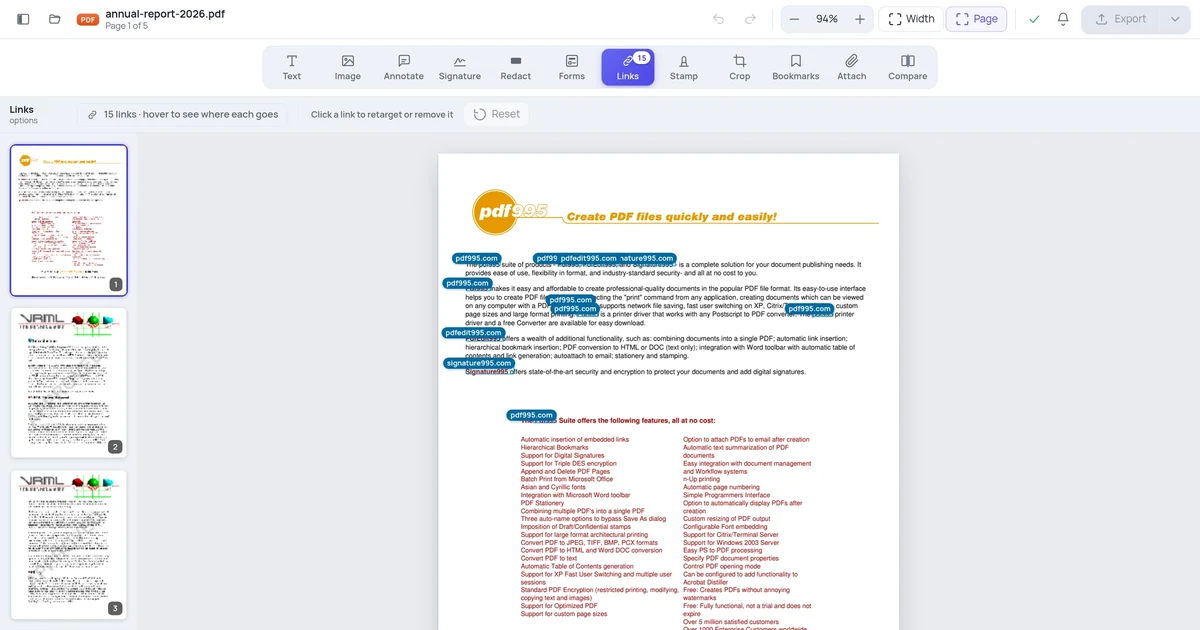
- Upload both PDFs. Drag in the destination file first, then the source file that contains the page you want. They appear as separate documents with page thumbnails.
- Arrange the documents. Drag the source file so it sits where the copied page should land — before, after, or between sections of the destination.
- Remove the pages you don't want. From the source file, delete every page except the one you are copying. You are left with the destination plus that single page in the right place.
- Confirm the order. Scroll the combined thumbnails and check the copied page sits exactly where you intended.
- Merge and download. Export the result. You get one PDF containing the original destination plus your copied page.
This works well when the source PDF is short. If the source is a 200-page document and you only want page 47, deleting 199 pages is tedious — that is where the extract-first method below is faster.
The clean way: extract the page first, then insert
When the source file is long, pull the single page out into its own small file first, then add only that file to your destination. It is two short steps instead of one long deletion.
- Extract the page from the source. Use a page-extraction workflow to save just the page you need as its own one-page PDF. Our guide on how to extract pages from a PDF into a new file walks through selecting one page and exporting it.
- Open the destination in the merge or editor tool. Bring in your main PDF.
- Add the one-page file. Upload the extracted page and drop it where it belongs.
- Set the exact spot. If you need it wedged between two specific pages rather than at the end, our walkthrough on how to insert pages from another PDF at a specific spot covers positioning precisely.
- Download the finished file.
The payoff is precision: you never touch the rest of the long source document, and the destination only ever sees the one page you wanted.
Which method should you use?
Both methods produce an identical result — the same page, the same quality. The right choice depends on the size of your source file and how exact the placement needs to be.
| Situation | Best method | Why |
|---|---|---|
| Source PDF is short (a few pages) | Merge, then delete extras | One step; trimming a handful of pages is quick |
| Source PDF is long (dozens of pages) | Extract the page first | Avoids deleting dozens of unwanted pages |
| Page must land between two exact pages | Extract, then insert at spot | Gives fine control over position |
| You want the page gone from the source too | Merge or edit, then delete it from the source | Lets you copy first, remove second |
| You need the same page repeated | Duplicate within the destination | No second file needed at all |
If you are copying a page only to repeat it inside the same document — say, a blank form page you need three times — you do not need a second PDF at all. Our guide on how to duplicate a page in a PDF handles that in a couple of clicks.
The catch nobody warns you about: orientation and page size
The merge or insert itself almost never fails. What trips people up is that the copied page arrives at a different size or orientation than the destination.
Here is why. A page copied from a landscape presentation lands in a portrait report exactly as it was — sideways relative to everything around it. PDFs do not auto-rotate or auto-resize pages to match their neighbors; each page keeps its own dimensions. So an A4 page dropped into a US Letter document, or a wide spreadsheet page slid into a tall memo, will simply look out of place even though nothing went wrong technically.
There are a few honest fixes:
- Rotate the page before exporting if it is merely turned the wrong way. Most merge and editor tools let you rotate a single thumbnail.
- Accept the mismatch if the content reads fine — a wide table on a wide page inside a portrait document is often perfectly acceptable.
- Recreate the page at the target size only if uniformity truly matters, for example a printed booklet where every page must be identical dimensions. This is more work and rarely necessary for everyday documents.
The second quiet gotcha is flattening. Some lower-quality tools rasterize pages — turning live text into a flat image — during conversion. A page that arrives as an image is no longer searchable or editable, and its text can look slightly soft. A proper page-level copy never does this; it carries the original page object across untouched. If your copied page suddenly cannot be selected with the cursor, the tool flattened it, and that is a sign to use a different one.
Platform variations
You can copy a page from one PDF to another on almost any device, but the experience differs.
- Online (any device): The most flexible route. A browser-based merge PDF tool works the same on Windows, Mac, ChromeOS, iPhone, and Android because nothing is installed. You upload, arrange, and download.
- Windows / Mac desktop apps: Adobe Acrobat and similar paid apps offer a thumbnail panel where you drag pages between two open PDFs. Powerful, but they are large installs and usually behind a subscription.
- Mac Preview: Free and built in. Open both PDFs, show thumbnails in each (View, then Thumbnails), and drag a page from one sidebar into the other. It is genuinely good for one-off copies — the main limit is that it only handles PDFs you can open locally and offers little control over exact placement.
- iPhone / iPad: The Files app lets you combine PDFs but gives almost no per-page control. For copying a specific page into a specific spot, an online tool in Safari is far easier than fighting the Files interface.
For a quick one-page copy on a Mac you already have everything you need in Preview. For precise placement, mixed page sizes, or doing it from a phone, the online route is steadier.
After the copy: tidy up and verify
Once the copied page is in place, give the finished file a real check rather than trusting it blind.
Scroll the whole document and confirm three things: the copied page is present, it is the right page, and it sits in the position you wanted. Then click into the copied page's text with your cursor — if you can select words, the page came across as real content and not a flattened image. Finally, check the page numbers and any cross-references still make sense, since inserting a page in the middle shifts everything after it.
If something is off — a page landed in the wrong spot, or you copied one page too many — you do not need to start over. Open the file in an online editor to drag pages back into order or delete the extra, then download again. Small corrections take seconds and beat re-running the whole copy.
A quick word on privacy and storage
When you use an online tool, both PDFs upload to a server, the page is copied across, and the finished file comes back to you. Files are processed on the server and not stored long-term, so the tool is not keeping a copy of your documents. Even so, treat PDFs the way you would any sensitive file — if a page contains an ID number, a signature, or financial details, only share the finished file with people who should see it.
FAQ
How do I move a page between two PDFs?
Open both PDFs in an online merge or editor tool, copy the page into the destination by merging or inserting it at the spot you want, then delete that same page from the source file and save it. Most tools copy by default, so moving is simply a copy followed by a deletion. Doing it in this order means you confirm the page landed safely before you remove the original.
Does copying a page reduce its quality?
No, not if the tool copies the actual page object. You are transferring the page's real text, fonts, and images, so it stays sharp, selectable, and searchable in the new file. Quality only drops if a low-quality tool flattens the page into an image during the process. If the copied page's text can no longer be selected with your cursor, the tool rasterized it, and you should switch to one that preserves page content.
Can I copy a page without affecting the original PDF?
Yes. Copying leaves your source file untouched — the page is duplicated into the destination, not cut out. The source only changes if you deliberately delete the page from it afterward. This is the safe default, which is why it is fine to experiment: you can always discard the merged result and your originals remain exactly as they were.
How do I copy several pages from one PDF to another?
The process is the same as for one page, just select the range. In a merge tool, upload both files and keep only the pages you want from the source before combining. For a long source, extract the range into its own file first, then insert that file into the destination. Keeping the pages in the right order on screen is what determines their order in the final PDF.
Why is my copied page sideways or the wrong size?
Because PDF pages keep their own dimensions and orientation when copied — they do not adjust to match their new neighbors. A landscape page copied into a portrait document stays landscape, and an A4 page dropped into a Letter file keeps its size. Rotate the page in the tool before exporting to fix orientation. A size mismatch is usually cosmetic and only worth recreating the page over if every page must be identical for print.