How to Duplicate a Page in a PDF
A step-by-step guide to duplicating a page in a PDF, copying it once or many times and placing each copy exactly where you want it in the document.

To duplicate a page in a PDF, open the file in an online editor, select the page you want to copy in the page panel, and choose Duplicate. An identical copy appears right after the original, keeping all its text, images, and formatting. Drag the copy to any position, repeat for more copies, then download the finished file. It takes under a minute.
Key takeaways
- Duplicating copies a page in place, producing an exact replica, identical text, images, and layout, within the same document.
- The fastest route is an online editor: select the page in the thumbnail panel, click Duplicate, and the copy lands right after the original.
- You can place the copy anywhere by dragging the new thumbnail to the spot you want, or duplicate several times for repeated forms.
- Copying within one file differs from copying between files — duplicating stays inside the document, while pulling a page from another PDF is a separate task.
- The common trap is losing track of page order, especially after several duplicates, so check the page count and sequence before you export.
- Fillable form fields can behave oddly when duplicated, sometimes sharing values across copies, which is the failure mode to watch for.
What "duplicate a page" actually means
Duplicating a page makes a second, identical copy of a page that already exists in your PDF and keeps it in the same file. Everything on the original comes along: the body text, the headings, any images, the background, the spacing, all of it. The copy is a faithful clone, not a screenshot or a flattened picture of the page.
It helps to separate two jobs that sound similar. Duplicating works inside one document, you take page 3 and end up with two copies of page 3 in the same PDF. Copying a page between two documents is a different task: you lift a page out of one file and drop it into another. If that's what you're after, our guide on how to copy a page from one PDF to another walks through it. This article stays inside a single file.
People reach for duplication more often than you'd think: a form page that repeats for each person on a list, a certificate template you'll print several times with small edits, a section divider you reuse between chapters, or a sample page kept as a backup before you edit the original. In every case the goal is the same: one more copy of a page you already have, ready to adjust.
How do I duplicate a page in a PDF?
Here is the direct path using an online editor. You upload the file, copy the page, place the copy, and download. Nothing to install.
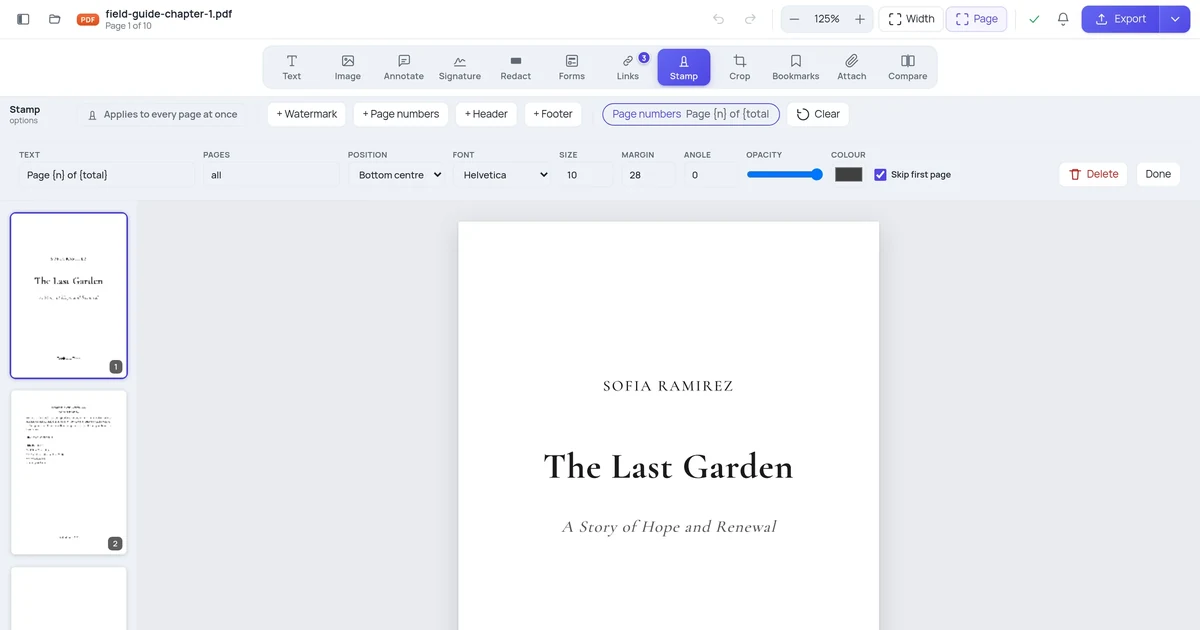
- Open your PDF in the editor. Go to the PDF editor and upload the file. It opens in your browser with a panel of page thumbnails, usually down the left side or along the bottom.
- Find the page you want to copy. Scroll the thumbnail panel and click the page so it's selected. A selected page is normally highlighted with a border or a different background.
- Choose Duplicate. Use the page menu, often a small "…" or right-click menu on the thumbnail, and pick Duplicate (some tools label it "Copy page"). An identical page appears immediately, placed right after the original.
- Move the copy where you want it. By default the duplicate sits next to the original. If you need it elsewhere, drag its thumbnail up or down the panel to the exact position.
- Repeat if you need more copies. Duplicate the same page again for a second, third, or tenth copy. Each new copy lands after the page you duplicated.
- Check the page order and count. Glance at the thumbnails to confirm the pages are in the sequence you expect and the total page number matches what you intended.
- Save and download. Export the file. Your duplicated pages travel with the PDF, identical to the source.
That's the whole job. The copy is a real PDF page, fully editable, so you can now change the text or images on the duplicate without touching the original.
The catch: page order gets confusing fast
Here's the part nobody warns you about. Duplicating one page is trivial. Duplicating several, or duplicating and then dragging copies around, is where people end up with a jumbled document.
Each duplicate drops in right after its source, which is tidy for a single copy but quickly muddles a long file. Make three copies of page 5 and you now have pages 5, 5, 5, 5 in a row, easy to lose your place. Then you start dragging them to different spots and the original numbering in your head stops matching reality. The result is a PDF where, say, the duplicate you meant for the end is sitting in the middle.
The fix is simple discipline: do your duplicating first, then do your reordering, then check the thumbnails before exporting. Don't interleave the two. Make all the copies you need, watch the running page count so you know how many you've created, and only then drag pages into their final order. A final scan of the thumbnail strip catches anything out of place. The page panel is your source of truth, not the order you remember clicking things.
Duplicating a page versus inserting one from elsewhere
It's worth knowing when duplication is the right tool and when a different approach fits better. These tasks overlap, so a quick comparison keeps you from reaching for the wrong one.
| Task | What it does | When to use it |
|---|---|---|
| Duplicate a page | Clones a page already in the file, in place | You need a repeat of a page you already have |
| Copy from another PDF | Pulls a page out of a different file into this one | The page you want lives in a separate document |
| Insert at a specific spot | Adds pages from another file at a chosen position | You're merging content and the placement matters |
| Add a blank page | Inserts an empty page to fill in fresh | You want to start a new page from scratch |
If the page you need already exists in your document, duplication is the cleanest move, no second file, no merging, just one more copy. If the page comes from somewhere else and the exact placement matters, our guide on how to insert pages from another PDF at a specific spot covers that workflow. And if you simply want a fresh empty page, adding a blank is faster than duplicating and erasing.
Platform notes: online, Windows, Mac, and phone
The online editor route works the same on any device with a browser, which is why it's the most reliable answer regardless of your operating system. That said, the built-in tools differ, and it's worth knowing what each one can and can't do.
- Online (any device). Upload, open the thumbnail panel, select the page, choose Duplicate, drag to position, download. Identical steps on Windows, Mac, ChromeOS, iPhone, or Android.
- Mac (Preview). Preview can duplicate within a file: open the sidebar thumbnails, select a page, copy it (Edit > Copy), then paste, or hold Option and drag the thumbnail to a new spot in the same sidebar to make a copy. It's serviceable for quick jobs.
- Windows. Windows has no built-in PDF page editor. The Edge browser opens PDFs but can't duplicate pages, so you'll use an online editor or installed software here.
- iPhone and Android. The Files app and most mobile PDF viewers show pages but don't duplicate them. A browser-based editor is the practical route on a phone, and the steps are the same as on desktop.
For anything beyond Mac's Preview, or when you want the same experience across every device, an online PDF editor saves the hassle of figuring out which local app does what.
The form-field gotcha (and the flattening trap)
Two surprises catch people when the page they're duplicating isn't just plain text.
Fillable form fields. If your page has interactive form fields, text boxes, checkboxes, dropdowns, duplicating the page can duplicate the fields with the same internal names. In the PDF format, two fields sharing a name share a value: type into one copy and the other copy fills in automatically. That's occasionally what you want, but usually it isn't, and it's baffling if you don't know to expect it. If you're duplicating a form page to fill it out separately for several people, plan to rename the fields on each copy, or fill and flatten one copy before making the next.
Flattening. Some duplication routes flatten the page, baking text and fields into a static image-like layer so they're no longer editable or selectable. A flattened duplicate looks identical but you can't change its text or tick its boxes anymore. A good editor keeps the copy fully editable; if your copy comes out "locked," that's flattening, and it means re-doing the copy with a tool that preserves the live content.
The safe habit: after you duplicate, click into the copy and confirm you can still select text and interact with any fields. Catching a flattened or value-linked copy early is far easier than discovering it after you've sent the file.
A worked example
Say you have a one-page event registration form and you need ten copies in a single PDF, one per attendee. You open the file in the editor, select the page, and choose Duplicate. Now you have two identical pages. You duplicate again until the thumbnail panel shows ten pages and the page count reads 10, no dragging needed, since each copy lands neatly after the last.
Because it's a form, you remember the field gotcha: you rename the name and email fields on each page (Name_1, Name_2, and so on) so they don't mirror each other, or you fill each page and flatten it before moving on. A final scroll through the thumbnails confirms ten clean pages in order, and you download. Ten registration slips from one original, done in a couple of minutes.
When duplicating isn't the right call
Duplication is perfect for repeating an existing page, but it's not always the best fit.
If you want the same edits on many copies, duplicate first, then edit one copy, then duplicate that edited page, rather than editing ten separate copies by hand. If you're building a document from pages scattered across several files, you're really merging, and pulling pages together with an insert workflow is cleaner than duplicating and replacing. And if you only need a blank page to write fresh content on, adding a blank page beats duplicating a full page and erasing everything on it.
A quick word on privacy, since you're uploading a document. An online editor processes your file on a server to make these changes, and files aren't kept long-term. That's normal for browser-based editing, but it's worth knowing before you upload anything sensitive.
FAQ
How do I copy a page within a PDF?
Open the PDF in an online editor, click the page in the thumbnail panel to select it, then choose Duplicate (sometimes labeled "Copy page") from the page menu. An identical copy appears right after the original, keeping all its text, images, and formatting. Drag the copy to wherever you want it in the document, then save and download the file.
Can I duplicate a page multiple times?
Yes. Select the page and choose Duplicate as many times as you need, each copy lands after the previous one. Watch the running page count so you know how many you've created, and check the thumbnail order before exporting. For repeated form pages, make all the copies first, then handle each one's content, so you don't lose track of which copy is which.
Will duplicating a page keep all the formatting?
It should. A proper duplicate is an exact clone, the same fonts, images, spacing, and layout as the original page. The one thing to verify is that the copy stays editable: if a tool flattens the page during copying, it bakes everything into a static layer you can no longer change. Click into the copy afterward and confirm you can still select and edit its text.
Why do my duplicated form fields share the same answers?
Because they share the same internal field name. In the PDF format, two fields with identical names hold one shared value, so typing in one copy fills the other. To keep copies independent, rename the fields on each duplicated page (for example Name_1, Name_2), or fill out and flatten one copy before duplicating the next. This is the most common surprise when duplicating form pages.
What's the difference between duplicating a page and copying from another PDF?
Duplicating works inside a single file: you clone a page that's already there and the copy stays in the same document. Copying from another PDF pulls a page out of a separate file and brings it into yours. Use duplication when the page already exists in your document, and the cross-file copy workflow when the page lives somewhere else.
Can I duplicate a page without installing software?
Yes. An online PDF editor lets you open the file, select a page, duplicate it, reorder the copies, and download the result, all in your browser, with nothing to install. It works the same on Windows, Mac, and phones, which makes it the most consistent option no matter what device you're on.