Numbered questions with a marks column
Independent text blocks for each question let you right-align "[4]" marks values into a clean column and renumber without reflowing the page.
Exam Paper Maker
An exam paper PDF has a strict anatomy: a title block with subject, duration, and total marks; a candidate-instructions box; then numbered questions with marks shown against each and answer space sized to the expected response. The free PDF Creator lets you build exactly that in the browser and export a print-ready paper — no license fee per test, no branding stamped on your questions.
Formality is a formatting problem. Right-align a marks value on every question line so the marks column runs down the page, box the instructions with a bordered rectangle, and rule answer spaces with thin line shapes so handwritten responses stay legible. Section headers ("Section A: Multiple Choice — 20 marks") divide the paper and let you state marks per section.
Duplicate the finished paper to spin off Set A and Set B with reordered questions, and keep a separate page at the end as your mark scheme — deleted before the student version is exported.
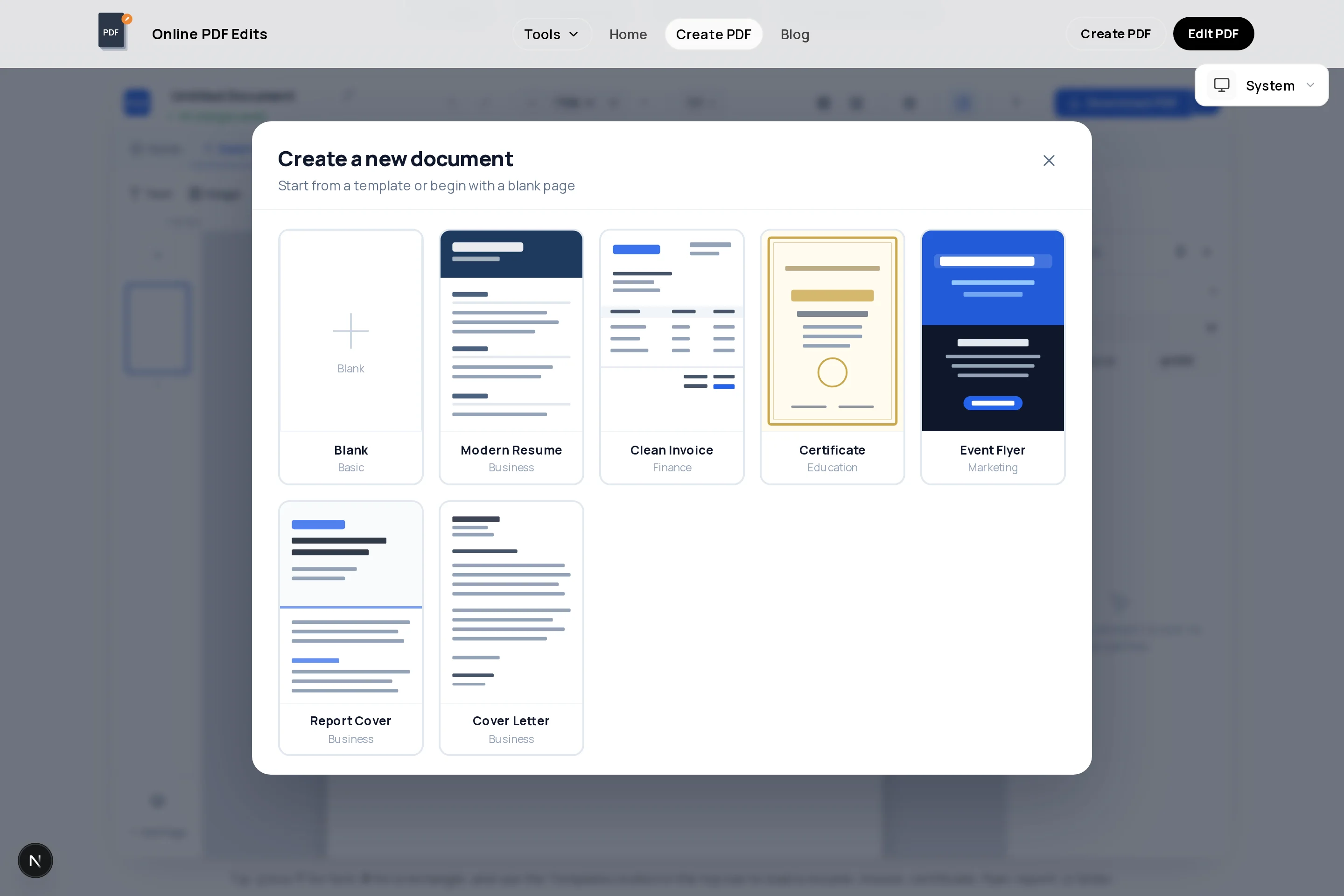
Independent text blocks for each question let you right-align "[4]" marks values into a clean column and renumber without reflowing the page.
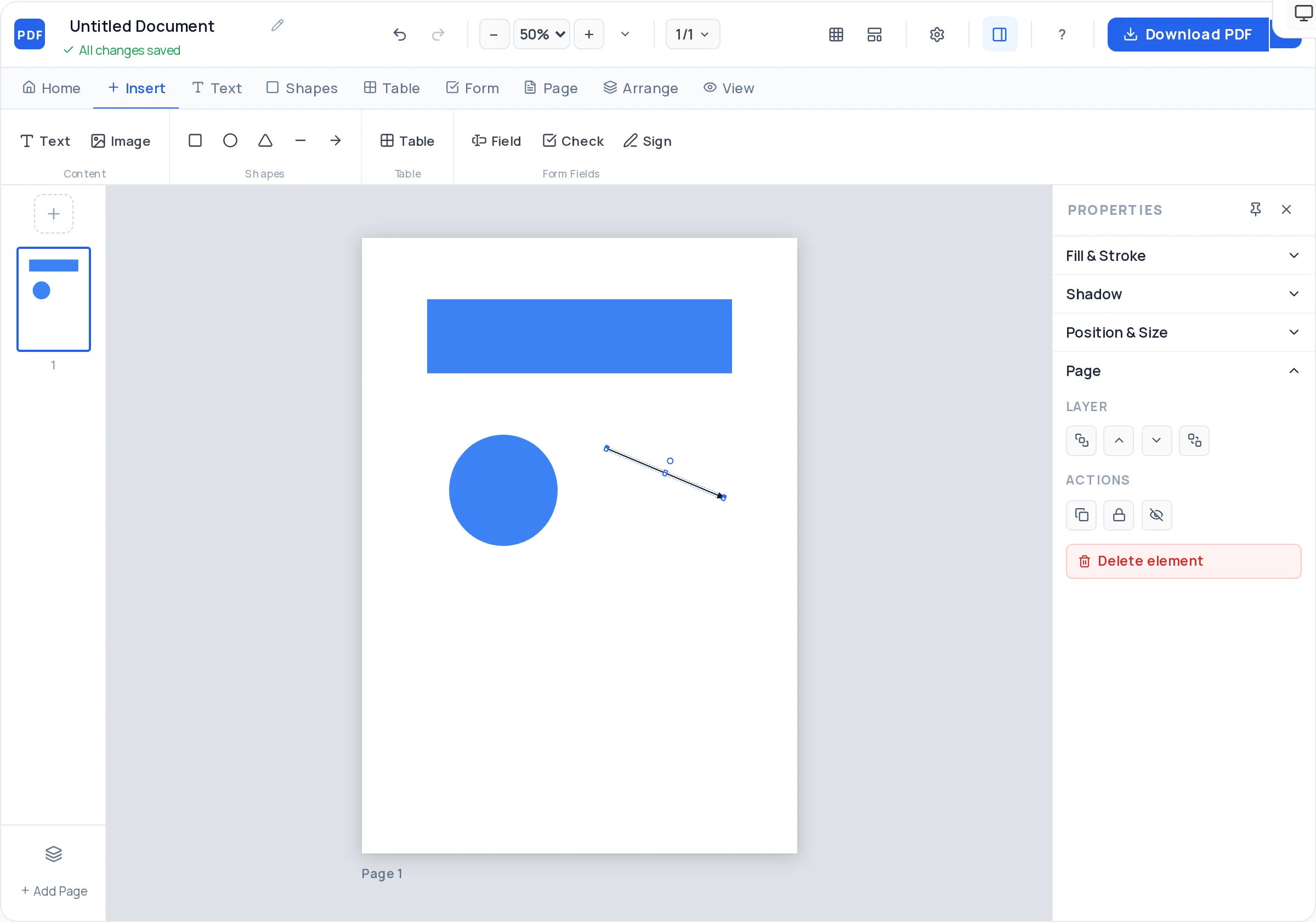
Thin line shapes create writing rules; bordered rectangles make answer boxes for working, diagrams, or single-word responses.
Tables handle marks-summary grids ("For examiner use only"), data sets students must analyze, and structured mark schemes for graders.
Add, reorder, and duplicate pages to organize Section A/B/C, create alternate test versions, or append a grading page.
Swap ruled lines for real text fields and checkboxes and the same paper becomes a type-in test students complete on screen.
Lock the header, instructions box, and page furniture so late question edits can never nudge the paper’s fixed structure.
At the top of a blank A4 page, add the institution name, subject and paper code, exam duration, date, and total marks.
Draw a bordered rectangle and list the rules inside: answer all questions, show working, where to write answers, calculator policy.
Create section headers with marks per section, then add each question as its own text block with its mark value right-aligned on the line.
Under each question, add ruled lines or an answer box proportional to the marks — roughly two lines per mark for written answers.
Total every question’s marks and confirm the sum matches the total in your title block and each section header.
Download the vector PDF and print it, or export a second fillable version with text fields for online sitting.
The most common exam-paper error is a title block promising 50 marks while the questions add to 48. Sum per section, then across sections, and check against the cover — every time you edit a question.
Students read space as a hint. A 6-mark explanation with three ruled lines invites underdeveloped answers; a 1-mark recall with half a page invites waffle. Around two lines per mark is a sane default for written responses.
Duration, total marks, whether all questions are compulsory, calculator rules, and where to write answers belong in one bordered block on page 1 — invigilators should never have to interpret your paper aloud.
An accessible opener settles nerves and gives weaker students traction; escalating difficulty inside a section discriminates better than a random shuffle.
Draft grading notes on a final page while writing questions, then delete that page before exporting the student version — the marks stay reconciled because they were written together.
Give each question’s mark value its own small text block, right-align it, and use snap-to-grid so every "[3]" sits at the same x-position down the page. The result is the classic right-hand marks column examiners expect.
Yes — place fillable text fields for written answers and checkboxes for multiple choice before exporting. The PDF becomes a real form students can complete in a browser or Adobe Reader and return by email or LMS upload.
Finish version A, then duplicate its pages and reorder the questions and answer options on the copies. Export each version separately, or keep both in one working file and delete the unused set before each export.
Export the paper, then password-protect it with /encrypt-pdf and share the password only when the exam starts. This is standard practice for emailed mock papers.
Yes. The export is a vector PDF, so question text, ruled answer lines, and table borders stay sharp on any printer — including high-volume copier runs for a full cohort.
No — exported papers are clean, with no watermark or footer branding. What you design is exactly what students receive.
Yes. Upload figures as images and place them beside the question, or add a source passage as a bordered text block. Data tables for interpretation questions are built with the table tool.
Add a small table on the cover with a row per question and columns for available and awarded marks, shading the header row. Markers fill it in by hand — or make the awarded column fillable fields.
All of these open the same free online PDF creator — each guide covers what makes that document work.
No signup, no watermark, nothing to install — design your document and download a clean, print-ready PDF in minutes.
Build your exam paper — free