True multi-page documents
Add, duplicate, reorder, and delete pages. A duplicated page keeps your heading style and margins, so page five looks like page one.
CV PDF Maker
A curriculum vitae is not a resume. Where a resume is a 1–2 page tailored pitch, a CV is the complete record — every degree, publication, grant, conference talk, and teaching appointment — and it grows over your career. This browser-based builder handles that length: add as many pages as your publication list needs and reorder sections as your career evolves, all without installing anything or paying anything.
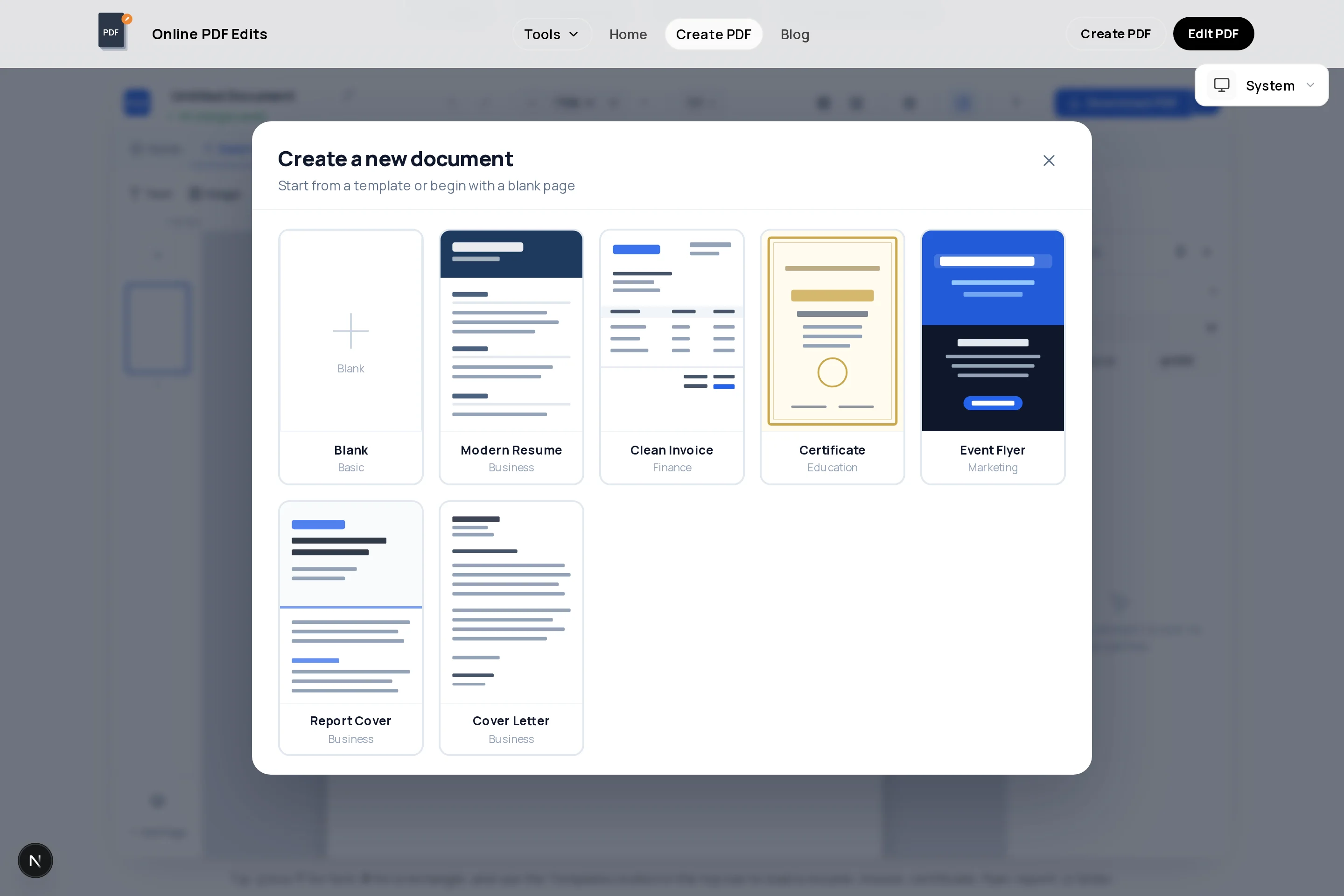
The preloaded template gives you the academic skeleton — name and affiliation up top, then education, appointments, publications, and service — which you extend by duplicating pages and text blocks. Tables with styled header rows keep long publication or grant lists aligned, and the export is a watermark-free vector PDF that hiring committees can search and quote from.
CVs are the default job-application document in the UK, Europe, and most of the world, and the required format for faculty, postdoc, fellowship, and many graduate-school applications in the US. The conventions below reflect academic practice, not corporate resume advice.
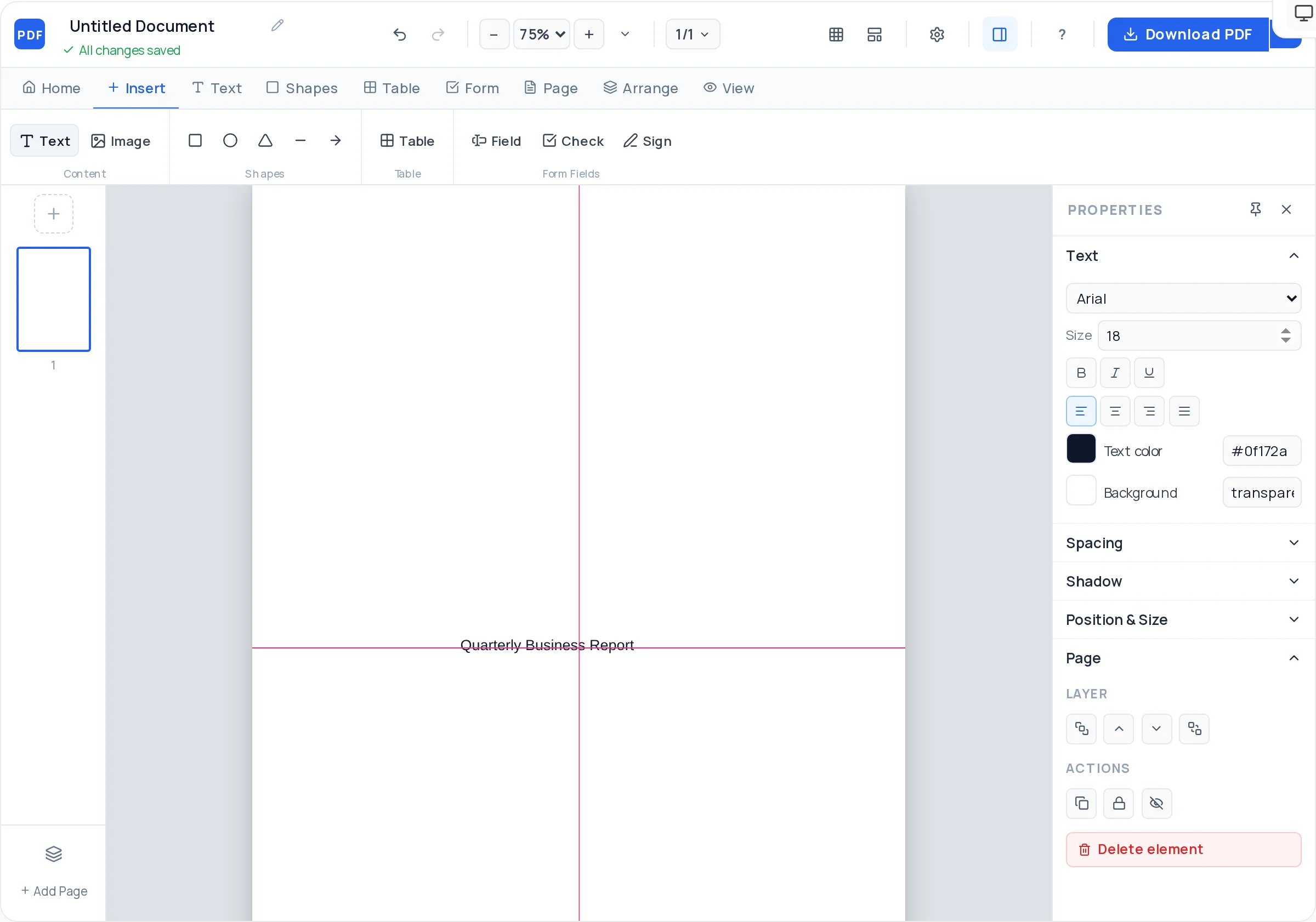
Add, duplicate, reorder, and delete pages. A duplicated page keeps your heading style and margins, so page five looks like page one.
Build any rows-by-columns table with a styled header row, borders, and cell padding — year, venue, and title stay aligned across a fifty-entry list.
Set one body font (Georgia and Times New Roman suit academic CVs), then control size, line height, and letter spacing so dense pages stay legible.
Smart guides, snap-to-grid, and arrow-key nudging keep dates in a clean left column and section rules perfectly flush across every page.
Lock your name block and section dividers so a late-night edit to the publications list cannot accidentally drag your header out of place.
Committees search CVs for names and venues. The exported PDF contains real selectable text, prints sharp, and never carries a watermark.
Launch the free Creator with the template preloaded, then switch the page size to A4 if you are applying outside North America.
Name, current position and institution, email, and ORCID or personal site. Academic CVs skip the personal summary — your record speaks for itself.
Unlike a resume, a CV leads with education: each degree with institution, year, and thesis title, followed by academic appointments in reverse-chronological order.
List every publication in one consistent citation format, grouped by type (journal articles, conference papers, chapters) and numbered so committees can reference them.
Funding with amounts and dates, courses taught with terms, then reviewing, committee work, and memberships. Duplicate pages as sections grow.
Download the watermark-free PDF, and keep the project as your master CV — update it every time something new is accepted, not the night before a deadline.
A CV omits nothing relevant: every peer-reviewed paper, talk, and grant belongs there. Cutting for length is resume thinking — a mid-career academic CV of 6–10 pages is normal.
APA, Chicago, or your field standard — it does not matter which, but every entry must match. Bold your own name in author lists so committees spot your contribution instantly.
Keep one always-current master document and derive tailored versions from it. Reconstructing three years of talks from old emails is how entries get lost.
Applying to a teaching college? Move teaching above publications. Research university? Publications and funding come first. The reader should hit your strongest section by page two.
Add "Updated June 2026" in the footer of the last page. Committees often hold CVs for months, and it signals the record is maintained.
A resume is a 1–2 page summary tailored to one specific job, standard for US and Canadian industry applications. A CV is the complete academic and professional record — publications, grants, teaching, service — with no length limit, used in academia worldwide and as the default application document in most countries outside North America.
As long as your genuine record requires. A new PhD graduate might have 2–3 pages; a senior professor can run past twenty. What matters is that nothing is padded — every line should be a real degree, publication, grant, or appointment.
Not for academic applications in the US or UK. In Germany, France, and much of continental Europe a photo remains common on professional CVs, and the builder supports rounded headshots if your target country expects one. When in doubt, leave it off.
Contact header, education, academic appointments, publications, grants and awards, conference presentations, teaching, and service — roughly in that order, with your strongest sections promoted for the specific role. Referees usually go last or on request.
Most PhD and many master’s programs ask for one. A grad-school CV emphasizes education, research experience, publications or posters if any, and relevant coursework — it is expected to be short, and that is fine at that stage.
Yes — nearly all academic portals and search committees expect PDF, and this tool exports a vector PDF whose text is fully searchable, so a committee member can find every mention of a co-author or venue.
No. The CV builder runs in your browser with no signup, and the exported PDF has no watermark and no page limit — a twelve-page CV downloads exactly like a two-page one.
All of these open the same free online PDF creator — each guide covers what makes that document work.
No signup, no watermark, nothing to install — design your document and download a clean, print-ready PDF in minutes.
Start your CV — free